

AI Panic – Our Macro & AI Outlook
Rising bond yields sparked a sell-off in AI shares this week. Whereas initially the AI buildout was largely financed by strong operating cash-flows of the internet giants and large cloud players; in recent quarters, even these big players are now burning cash in order to accelerate their AI buildouts.
The reason is simple—as we calculated last week; revenue generation from AI is already very strong and the IRR on the massive AI buildout over the past 2.5 years is very attractive. Financial commentators all take into account the massive AI capex that Meta and Google are making, but attribute zero benefit from AI to their growth acceleration in ad revenues. We think this is a very flawed assumption as we detailed below.

Over the past 2.5 years—since the start of the AI data center buildout—typically it cost around $38 billion to build one gigawatt of AI capacity. At current market rates, you can rent out that capacity at $60 billion per annum (based on SpaceX’s latest deals). So, anyone who made that investment over the last 2.5 years and now has capacity available is currently printing money with those GPUs. The payback on that data center is less than one year.
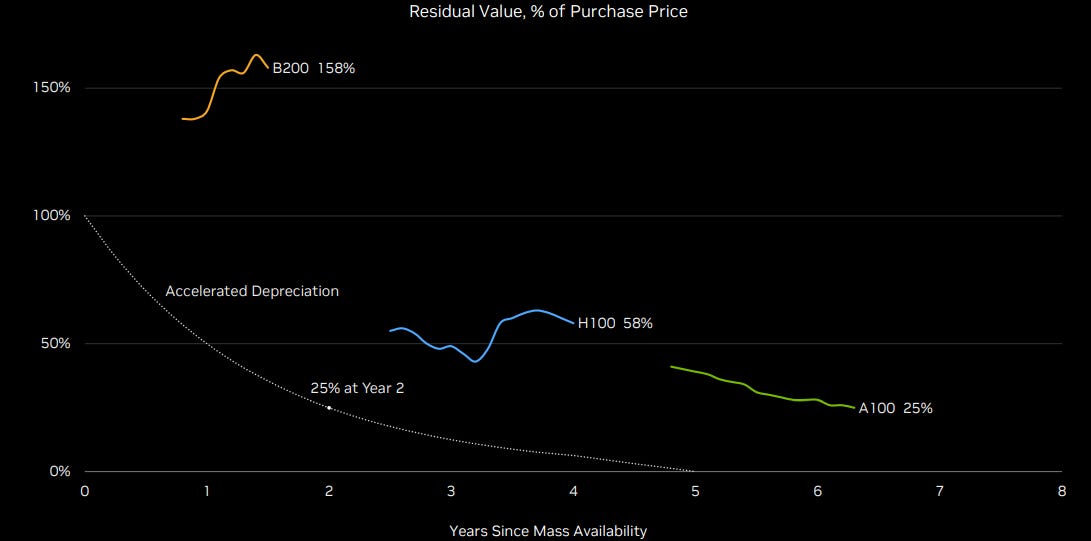
Even better, according to Nvidia’s data, those GPUs will run for six years or even longer. Nvidia shows that 6.5 years old A100s are currently being sold at 25% of the original purchase price still, while recent GPU versions are being sold at a premium:
However, with bond yields now spiking, this is putting pressure on the AI buildout as it’s partly also being financed with debt. Smaller fish such as the neoclouds, for example, are heavily financing their data center buildouts with leverage.
Over the past few weeks, France has been at the center of the storm in the bond markets, with spreads widening to similar levels to those seen during the Eurozone government debt crisis of 2012.
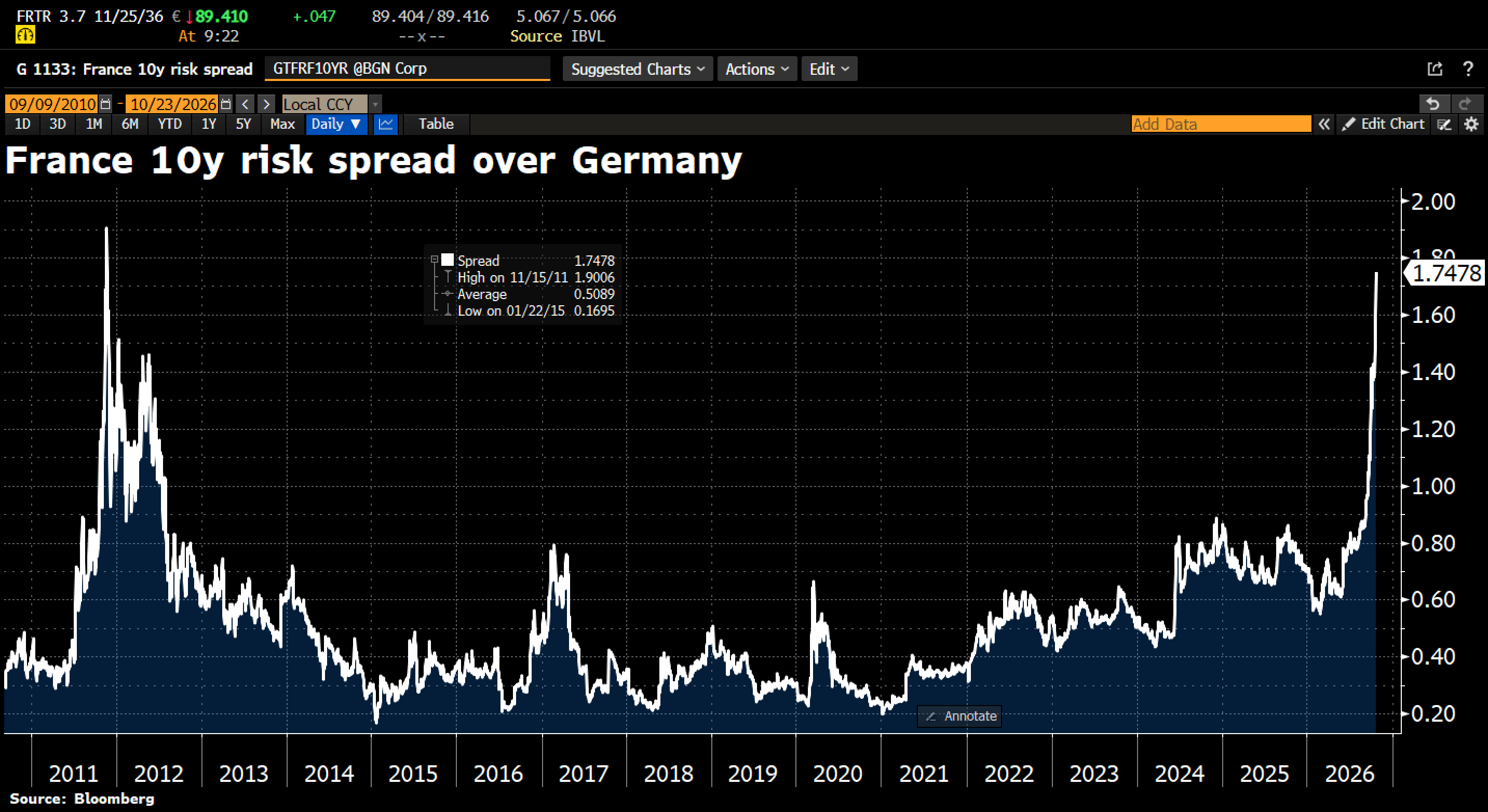
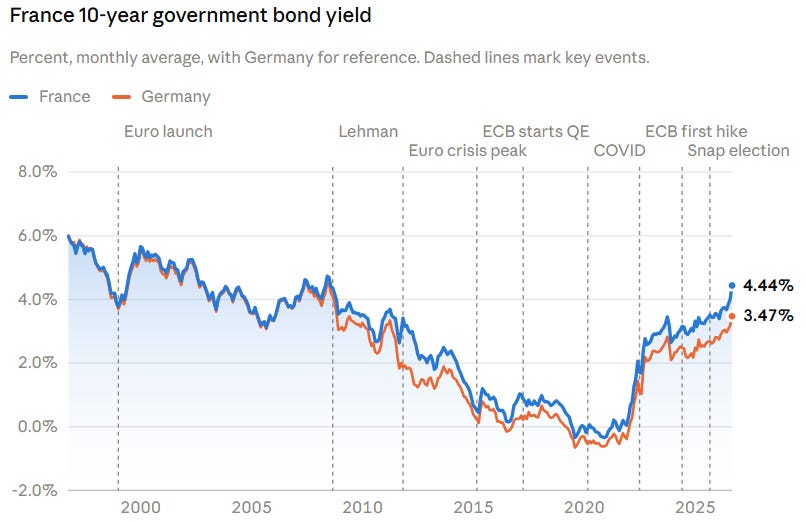
Investors who purchased French government bonds at negative rates over the 2019-2021 period might well have made the worst investment ever. They essentially purchased bonds which they thought were risk-free, they’re still paying the French government currently to hold their money, and they might never get their money back as left-wing political candidates are now talking about simply ‘cancelling the debt’.
Louis Gave from Gavekal explains the dire situation France is facing on the Macro Voices podcast:
“France has been running roughshod around all the various European rules, running budget deficits essentially of 5% of GDP. You could easily tell me “yeah, so what, other countries do so.” I think there are a few massive differences for France today which explain why France has essentially started what looks and feels like a typical emerging market debt crisis. You could say, well, the US is running budget deficits of 7% of GDP and that seems to be going well. Why should France hit the skids at five? There are a few things to consider.
The first is that France’s ability to increase taxes is essentially zero. France’s total tax receipts account for roughly 44% of GDP. In the US you’re at about 24–25%. So right now in France, we’re on the wrong side of the Laffer curve. If we try to meet these massive budget deficits through tax increases, we’ll actually be raising less money. That’s the first problem.
The second massive problem is that a majority of our debt is now owned by foreigners. I just spent the past couple of weeks on the road meeting with clients, and it was actually interesting. The first question most clients ask is: at what level of yield should I buy US government bonds? Are we there yet? Have yields risen enough in the US that bonds are now attractive? That’s the first question. And invariably, the second one almost in the same breath is: who’s stupid enough to own French bonds here? Who’s going to be the bag holder of this unfolding train wreck?
For a lot of people owning France—and especially French debt—has now become a career risk. If you buy French bonds and France ends up restructuring its debt or the euro blows up or whatever else, you look like an idiot because for the past couple of years it’s been all over the Wall Street Journal and this was one of the most predictable crises ever. So that’s the second issue.
But the third issue—I mentioned that France was going through some kind of emerging market debt crisis. The reality is, like an emerging market, France has issued a bunch of debt in a currency that we can’t print. We depend on other people to print the money to bind us over at this stage, and that’s the crux of the matter. Now you could say, “well, the ECB will, push comes to shove. At the end of the day, the ECB is run by a French lady, so push comes to shove, things will happen.” Which, as an aside, is perhaps one of the oddest things right now in the market: while France is on fire, the market is still pricing in three rate hikes from the ECB. That’s never going to happen. The ECB is never going to have three rate hikes.
But in any event, what we have today in France is a confluence of different crises. We have a fiscal crisis, we have an energy crisis, we have an economic crisis, we have a social crisis, and we have a political crisis all at once. And all this is occurring at a time when we have a president who’s in office but not in power. His opinion polls at this stage are down in the low teens and he has absolutely no authority whatsoever. And so with this lack of authority, riots are running wild. When you look at France, the bottom line is if we want to get out of our current economic bind, there’s only two choices. Either we have to move the retirement age to 70 years old, option one, which is extremely hard to do, or like in any good emerging market crisis, you have to devalue the currency by 50%. But within the euro, that’s not possible.
One of the very disappointing things of this French presidential election that is coming up in six months is you have lots of candidates but not a single candidate proposing either of these options, when economically you’re going to need to do one or the other and perhaps both. What you do have is a far-left candidate essentially saying look, we need to default on the debt, which, once a majority of your debt is held by foreigners, is actually not completely stupid. So for Italy, for example, it makes no sense for Italy to default on its debt because 80% of the debt is held by Italians. Why would you default on your own people?
Defaulting on foreigners—yeah, maybe that makes sense. But, if you go down this path, you’re essentially bankrupting the entire European insurance industry. France has issued more debt than the entire African continent. A lot of our debt is essentially held by European pension funds and European insurance companies. So the first thing you do if France goes down this path is essentially blow up the European insurance industry and probably the global one, because Japanese insurance companies, US insurance companies, a lot of people own French debt.
The second issue, we have three banks in France that are systemically important banks and that are huge in the derivatives markets. If all of a sudden French debt is redenominated, the balance sheets of a lot of these banks, they have liabilities in euros, all of a sudden their assets are redenominated in a French franc that loses 40%. That could create some serious mishap. Let’s not pretend that this would be easy and that it would not be deeply disturbing for global financial markets.
The reality is, if France defaults on its debt, restructures its debt, leaves the euro—pick any scenario—if any one of those things happens, it’s very hard to see the euro surviving as it is today because at that point the European financial industry, the banks, the insurance companies, basically all face catastrophic losses and every country will need to nationalize their own debt.”
So, this sounds pretty bad—the situation in France could spark a wider financial crisis due to its contagion effects. However, we’d make a few points here.
In hindsight, although there was substantial market turmoil at the time, the Euro debt crisis 1.0 was actually resolved pretty easily. On July 26, 2012, ECB President Mario Draghi spoke three magic words—“whatever it takes”. Basically, he signaled to markets that the ECB would purchase as many government bonds as necessary in order to keep borrowing yields under control. After this, markets calmed down and bond yields kept declining for another 8 years.
Obviously, if we get a similar solution now—with the ECB basically promising to purchase as much Eurozone government debt as necessary—the problems will come back at some stage in the future. Governments will keep running large deficits, government debt will keep building, and at some stage you run into serious macro consequences such as high inflation rates. Argentina, Turkey, and other emerging markets are well aware of this. In Europe, however, besides the Germans, most politicians are likely ignorant of this topic.
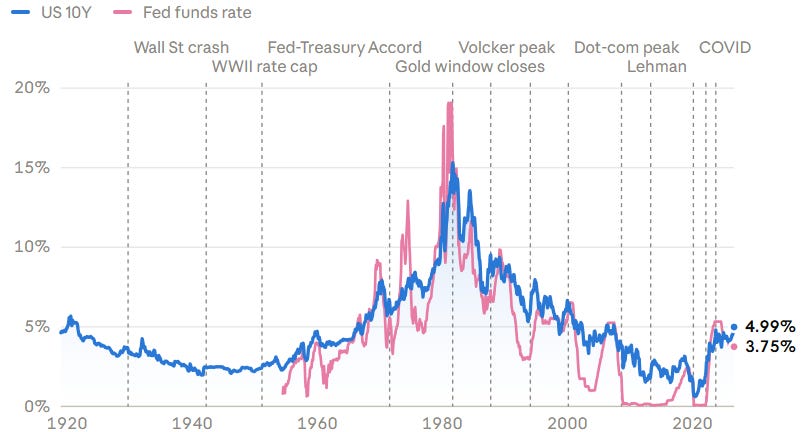
We’re less concerned about high bond yields in the US. If you look at long term history, bond yields have actually simply normalized in recent years. Historically, the US economy has also functioned well with bond yields at 5% and even higher.
Taking a contrarian view on the macro, more from a bottom-up perspective, we estimate that AI will be a hugely deflationary force in the world. What took a programmer two years to code, Claude can now do in a single day. All sorts of basic digital tasks can now be replaced with smaller, open-source LLMs at prices that are not much more expensive than electricity. At the same time, AI is driving huge productivity gains and advances in engineering, sciences, legal work, research, etc. We see both simple and advanced AI models making large contributions to the global economy over time, which should be highly deflationary and push interest rates down again.
Blackstone’s President during a recent presentation mentioned that US productivity growth has started to accelerate:
“Annual US productivity growth, which for a decade, you know, averaged 1.5%, is now 2.6% over the last two and a half years. It’s hard to say how much is AI-driven, but something is happening out there and we’re beginning to see it. Productivity has made a step function move upward.
The tip of the spear is the hyperscalers. Their revenue per employee has grown 65% over a 3.5-year period as they adopt these technologies. And of course, it’s showing up in margins. The EBITDA margins for the S&P and our portfolio companies are up 500 and 700 basis points over this four-year period of time. And if you talk to our CEOs, they would tell you the next 12 months are going to be very positive as well.”
When it comes to high government debt levels, Japan shows that nations can survive on extremely high levels of government debt. While many macro economists have been screaming for 30 years now that Japan is going to collapse, so far this hasn’t happened.
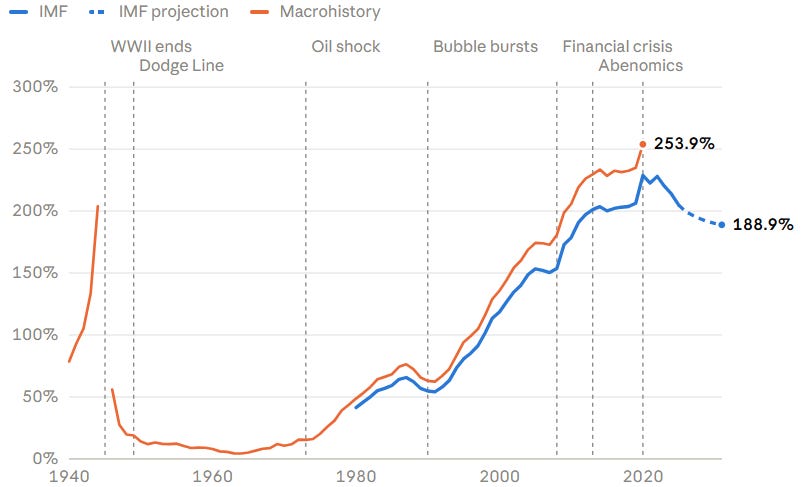
Of course, we wish that governments across the world would be running small surpluses and have virtually no debt at all, it would be much better, but we’re not seeing anything above that makes us want to sell our equity portfolio and panic.
Another large binary risk, however, is a potential energy crisis. According to news reports, the US has prepared a three day strike plan to finish the Iran conflict. Basically, the US has been monitoring all communications of the IRGC over the last six months and so they know exactly where all Iranian nodes are operating from. However, the risk is that the Iranians would successfully retaliate and take out energy infrastructure across the Gulf countries. A recent article in CBC highlighted the risks of this strategy:
Citrinowicz, who’s with Israel’s Institute for National Security Studies, said a third round of war could be the worst yet, based on what Iranian officials are telegraphing.
“They will attack the energy facilities in the Gulf. But more than that, they will cause significant damage to civilian infrastructure, communications, as well as cutting off the internet lines going under [the] Hormuz Strait,” he said.
He said there is even a possibility that Iran could push some of its massive land army into the fight with limited assaults against Gulf countries that house U.S. bases, such as Kuwait and Bahrain.
“We’ll see a regional war with Iran investing a lot in attacking the U.S. presence in the region to cause maximum economical damage to the U.S. international economy.”
Obviously, this is a substantial risk for the global economy and if Iran would successfully take out energy infrastructure across the Gulf, we expect a strong market sell-off. However, this is the reason that we typically invest in extremely strong companies and with no leverage in the portfolio. When you invest in the types of companies where if you look out five years or longer, and you can only imagine share prices being substantially higher regardless of all the possible scenarios when it comes to the macro environment, this allows you to go through short term market turmoil much easier.
What we typically do during times of market volatility, is simply go through the list of holdings in our portfolio and review valuations. Typically, we find valuations extremely attractive and that makes us want to buy more of those names. But, of course, for this strategy to be successful, the quality of your portfolio holdings has to be good.
For example, when it comes to investing in AI clouds, we hold a large position in Amazon but we don’t hold any CoreWeave. This turned out to be a good call in the current environment of rising interest rates and it allows our portfolio to navigate current macro turmoil much easier.
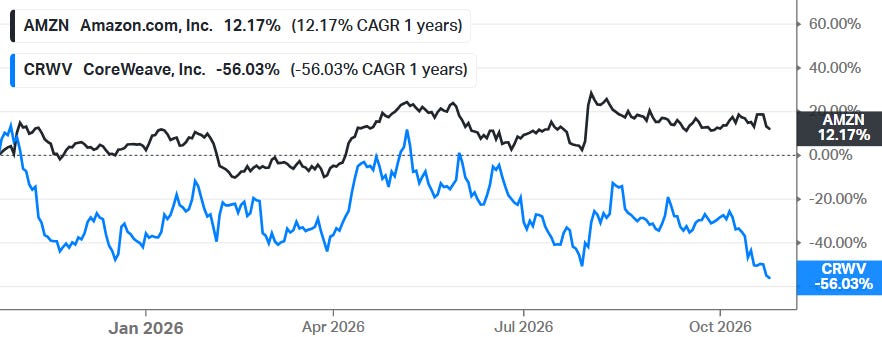
While CoreWeave has a massive AI backlog for a neocloud, all of this data center capex will have to be financed with debt. CoreWeave is operating on extremely high leverage and this makes the market nervous in the current environment.
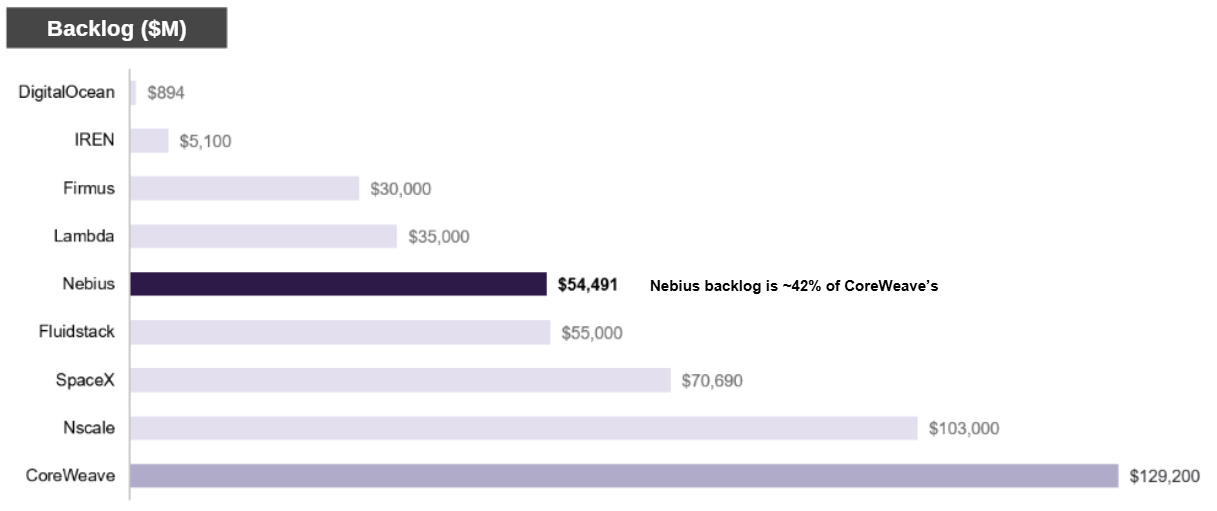
However, it’s not all doom and gloom for CoreWeave. As we discussed in our opening, AI is actually generating attractive revenues already while AI capacity is still seeing huge shortages. This gives scope for CoreWeave to increase pricing on new contracts over time. Goldman thinks that also financing costs will remain under control:
“Going back to Finance 101, we see CoreWeave’s enterprise value as being directly correlated to the magnitude and durability of the spread between its unlevered IRR and WACC — and we think investors may be underestimating the magnitude of upward revisions to uIRR, and overestimating the magnitude of upward revisions to WACC:
We believe CoreWeave’s ARR per MW, and therefore unlevered IRR, is biased to the upside in the next 24 months because of tight supply, as well as our view that CoreWeave is differentiated from other neoclouds in its performance/cost metrics and its ability to execute on ramping new supply;
We estimate CoreWeave’s blended cost of debt could move 100-200bps but likely not more than that, ultimately putting a cap on WACC such that equity return profiles will still be attractive, based on feedback from our industry credit conversations. While unsecured debt trades at 13.5-15.0% YTW (Yield to Worst), we do not think that this would be representative of the company’s new cost of financing as CoreWeave’s financing structure is primarily asset-based.”
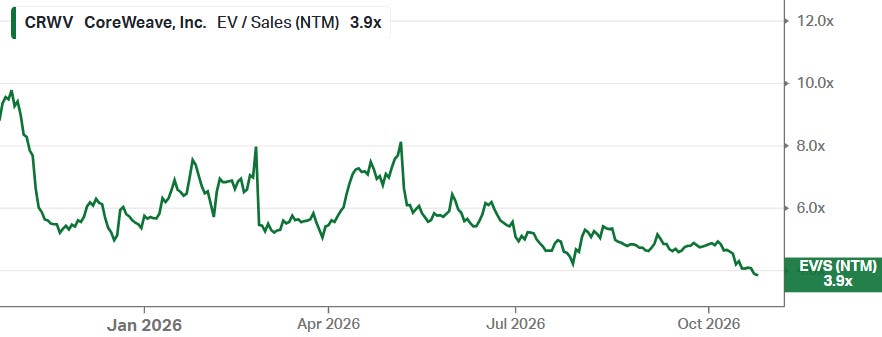
With CoreWeave now trading at 4x forward Sales, we do think there is an investment case here given the company’s strong growth profile and the attractive outlook in AI. However, we prefer to hold large positions in the big cloud platforms as we see these as much superior platforms to run enterprise cloud workloads on—neoclouds can’t handle most of these workloads, they largely provide just GPUs—and with a much lower risk profile, especially in the current environment.
Despite the macro turmoil, everything is still looking strong in semis. Deutsche notes that mature semis, for example, are seeing strong price increases:
“In partnership with dbDataInsights, we have been conducting a weekly scrape of chip pricing of mainly analog/discrete/MCU components sold into the distributor channel (>1,500 SKUs). During October, the trend is one of intensifying tightness with mature chip pricing trending upwards as shortage conditions spread from specific lagging-edge categories (where AI demand plays an outsized role) to a broad-based picture of tightness across mature process nodes, not helped by TSMC. Lead times in power discretes have reached 40-52 weeks, with a demand pickup also seen in SiC MOSFETs. Notably, onsemi announced a sweeping price increase of 10-20%, which took effect on October 10th. In analog, lead times at TI and ADI have extended in some parts up to 60-70 weeks. However, outside of power/analog, allocation notices have become more common in certain 32-bit MCU families (eg STM32 lead times extended to 40-52 weeks, Infineon, Renesas). Lastly, passives (notably high-end MLCCs) continue to see stretched lead times.”
Texas Instruments is seeing broad-based demand strength across the data center and industrial end markets—including aerospace and defense, energy infrastructure, test and measurement, and robotics:
“The data center market, it’s a market that we see strong secular growth. I don’t think it’s influenced by seasonality. The demand continues to be strong and growing. It’s just a bigger part of our business now. It was about 13% of revenue in Q3 or so. On top of it, I’m very excited about what we are seeing on the industrial market. We are seeing a very strong momentum in industrial across the sectors, but specifically in areas like aerospace and defense, energy infrastructure, test and measurement, the robotics sector. So this is where we see a combination of secular growth, but also sequential or cyclical recovery. So this is why we were seeing an above-seasonal forecast from TI. We also saw the automotive customers waking up, if you will, with higher demand in Q3, and I think that may continue into Q4. So again, the top 3 markets, industrial, automotive and data center, are the ones that are driving our guide into Q4.”
Semi shortages are even worse at the leading edge, which powers the AI workloads. Deutsche doesn’t expect supply to catch up with demand until 2029:
“The leading-edge logic and memory shortage remains acute. On the foundry side, we don’t expect supply to catch up with demand until 2029, and today lead times are heavily extended on advanced nodes (2-3nm), stretching to nearly 3 years at some extremes. On the memory side, there has been significant discussion since the summer around HBM de-speccing back down to 8-hi stacks to drive higher xPU volumes, but more recently there have been reports around execution issues tied to MR-MUF at SK Hynix with 12-hi stacks, which feels more intuitive. Either way, DRAM serving non-hyperscalers remains extremely tight, with the best supply alternatives coming from China (eg CXMT). As for server CPUs, Fusion reports that lead times of Intel SKUs sit at around 50 weeks. EUV has also become a bottleneck.”
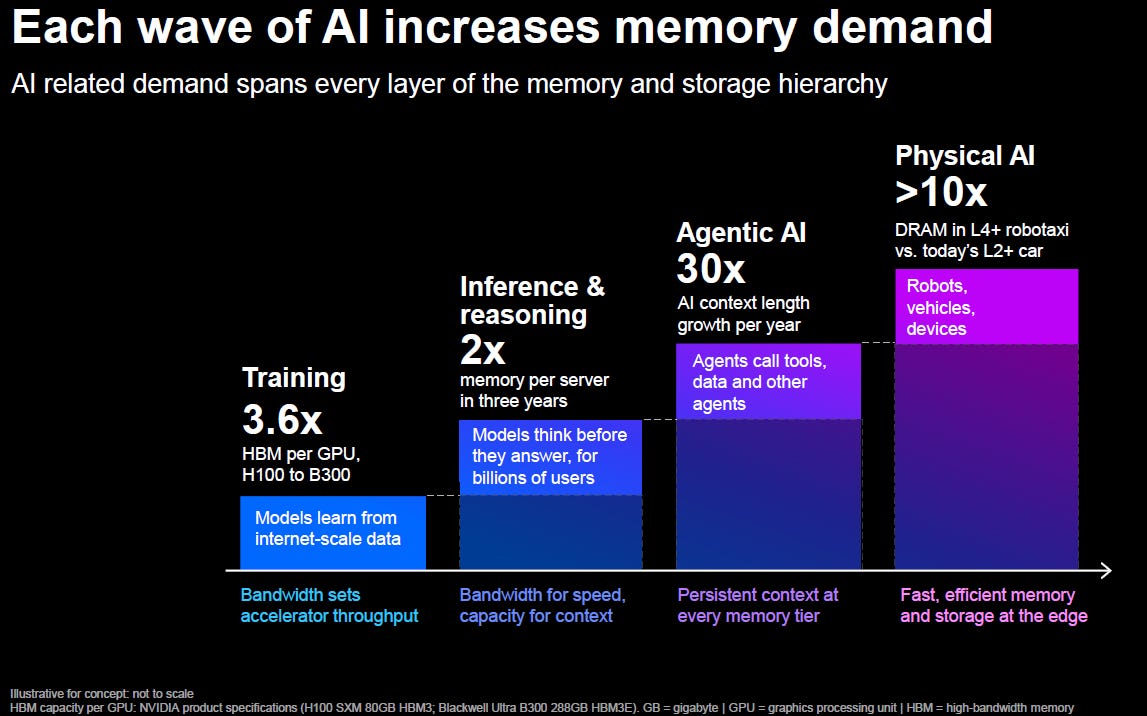
There were concerns in the market around memory de-speccing, however, the long term trend is that advanced AI will continue to become more memory intensive. Micron had a nice chart on this topic at their tech symposium this week:
Overall, while we can’t forecast what’s going to happen in the Middle East, we do think there is a lot of cause for optimism when it comes to AI and tech in the coming years. We can see scenarios where there is substantial market turmoil in the coming months, however, we feel very comfortable with the quality and valuations of the businesses we own. So, we wouldn’t sell any of our holdings, although a partial hedge via futures contracts could be appropriate at some stage to reduce volatility.
While some macro fundamentals look dire—especially when it comes to government finances—we can see AI improving macro fundamentals over time by raising productivity growth and bringing down prices. This should result in higher GDP growth, lower inflation, lower interest rates, higher corporate margins, and even increased government efficiency (which can help lower high current deficits).
Next, we will go through in more detail on how we’re positioning in the AI ecosystem, and we’ll discuss our broader findings on the following topics:
Personal AI Agents – Winners & Losers
Micron Technology Day – Implications for Semicap