

AI’s Attractive IRR & Anthropic’s Outlook
Anthropic’s slowing growth rates created substantial anxiety in the market this week. For example, Reuters discussed a lower valuation for the company’s upcoming IPO:
“Some current Anthropic investors and prospective investors in its upcoming initial public offering are weighing a lower valuation for the AI company after its latest financial disclosures, four people familiar with the matter said, amid broader concerns over the ballooning cost of financing AI.
Some investors who attended Anthropic’s investor day on Wednesday in San Francisco discussed a valuation of around $1.5 trillion, three of the people said, a significant step down from the roughly $2 trillion valuation that investors had previously expected for the November share sale.”
The reason is that over the past two months, sequential growth rates for Anthropic slowed to below 7% month-on-month. We can also see that OpenAI’s ARR growth accelerated to 16-19%:
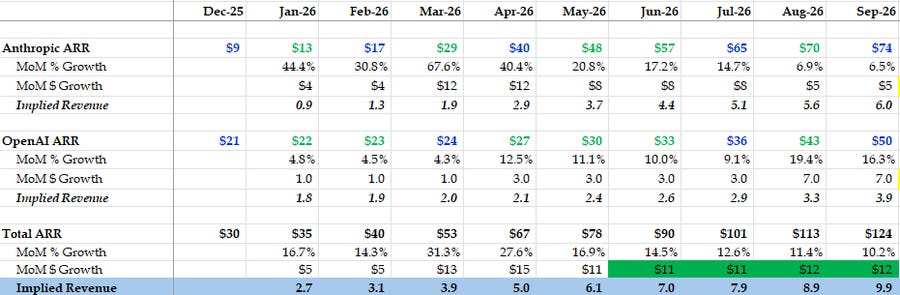
However, we’d make a few points here. Firstly, there is seasonality. Most people take their annual holiday in August, and so one would expect enterprise token demand to be lower in that month. Despite this, both Anthropic and OpenAI still showed attractive growth.
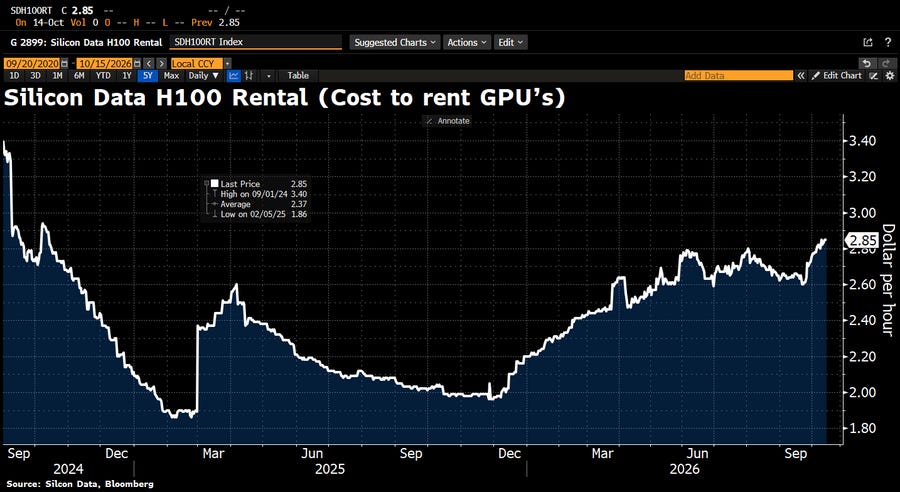
Confirming the seasonality—we can see that GPU pricing weakened over August and recently started picking up again. Therefore, we expect Anthropic’s ARR growth to accelerate again in the coming months.
Secondly, September is the month that OpenAI released Astra. You would expect dollars to shift to Astra to try it out. For example, we did a large coding project with Astra last month. However, this month, we’ve already switched back to Claude. Astra is definitely a smart model but overall Opus 5.5 is the far more productive and better model to work with. And now Anthropic will be releasing the new Fable in the coming month, which no doubt will again even have stronger capabilities.
At the same time, these models are becoming spectacularly good at a large variety of tasks—3D design, coding, science, data analysis, biology, legal and medical analysis, research, etc. For these reasons, we actually think that the outlook for both Anthropic and OpenAI remains very attractive.
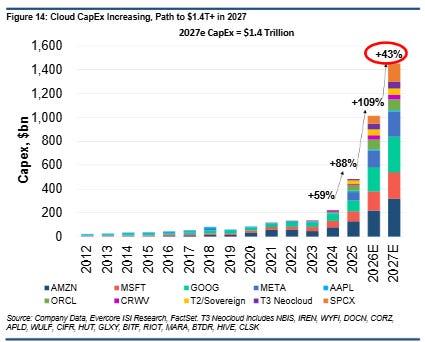
While many have been screaming “bubble” now for three years, even despite the massive cloud capex increases of the last years, each dollar of this capex so far has been justified and is actually making an attractive IRR based on our calculations. We’ll go through the math next.
First, the two frontier labs are currently doing $124 billion in ARR. If we gross OpenAI’s numbers—OpenAI strips out the revenue cut for cloud partners, who resell their models, while Anthropic includes these—we already get to $142 billion in ARR that end users are paying for these models.
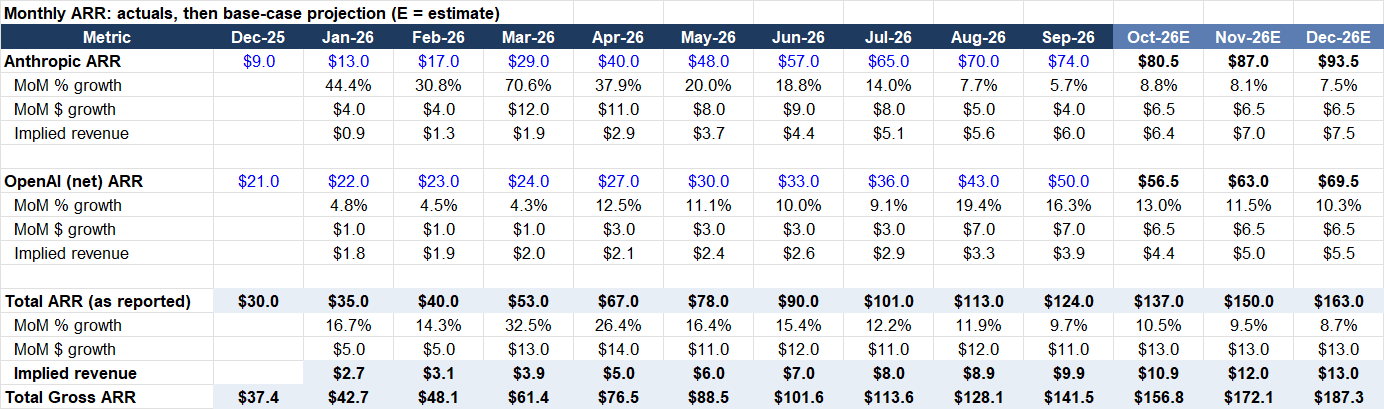
At the same time, both OpenAI and Anthropic continue to show healthy growth while the capabilities of their models continue to improve at a brisk pace. LLMs are seeing increasing adoption in more and more end applications. Therefore, we estimate close to $187 billion in ARR that end users will be spending on these models by year end (total gross ARR line at the bottom of the model):
Second, AI returns are showing up as accelerating revenue growth inside the internet giants’ existing businesses. Macro pundits—who are generally very negative on AI—won’t be aware of this as they never actually listen to tech earnings calls. But a large variety of online apps have been discussing tremendous gains from better ad targeting, better ad placement, and better creatives thanks to AI. This includes also smaller ad networks such as Applovin and Unity.
However, the biggest gains were made by the big internet giants. For example, in Q2, Meta grew advertising revenue 27% year over year (ARR $237 billion) while Google grew search revenue 17% (ARR $253 billion) and Youtube ads at a 13% rate (ARR $44 billion). Both of these have regularly mentioned AI as the key contributor to their accelerating revenue gains over the past few years. For example, this is Zuck on the Q2 Meta call:
“First, we are now at a point where our investments in AI are accelerating every major part of our core business. They’re improving the experience for people using our apps, driving better performance for advertisers and helping our teams build new experiences and ship faster.”
And on the Q4 call of last year:
“Our business also performed very well, thanks to record-breaking holiday demand and AI-driven performance gains. We are now seeing a major AI acceleration. I expect 2026 to be a year where this wave accelerates even further on several fronts. We’re starting to see agents really work. This will unlock the ability to build completely new products and transform how we work.”
Same on Google’s call, this is Sundar:
“Our AI investments are redefining what’s possible across every part of our business. Our momentum starts with Search, where people are adopting one seamless search experience across AI Overviews and AI Mode. We saw 17% revenue growth in Search and Other and YouTube ads grew 13%.”
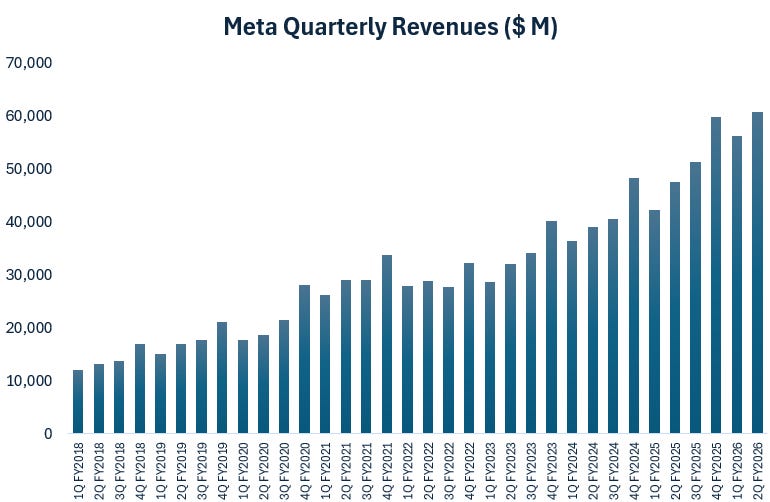
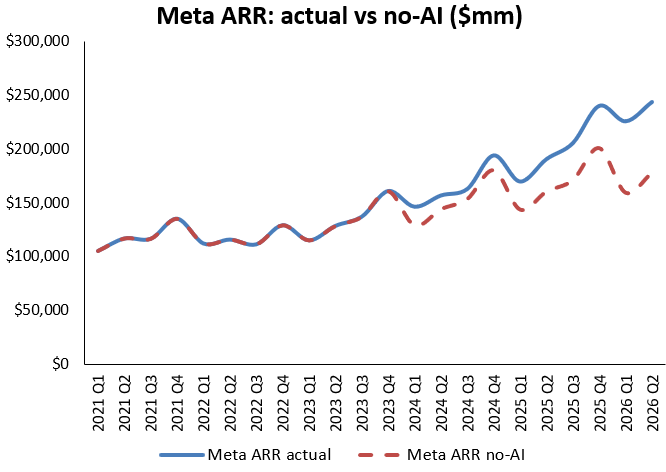
The numbers actually prove these statements. For example, Meta revenues were almost flat from Q1 of 2021 to Q1 of 2023. As from 2023—the year when transformer-based AI models really took off—Meta has steeply accelerated revenue generation. Basically, the company went from $114 billion ARR to $243 billion in ARR currently. That’s a $129 billion gain in ARR since 2023.
Assuming Meta’s benefits from new AI systems only kicked in as from 2024, we calculate a normalized ex-AI ARR for Meta based on normalized, mature growth rates. We estimate overall $178 billion in normalized ARR for Meta without the recent breakthroughs in AI. This suggests that AI added $65 billion in ARR for Meta over the past 2.5 years (the gap between the red and blue lines).
If we do a similar exercise for Google, we can see a similar picture. Quarterly ads revenues (Search + YouTube) grew strongly as from 2023—from a $188 billion ARR in Q1 of 2023 to $297 billion in ARR currently, a $109 billion gain.
Assuming AI benefits only really started kicking in as from 2024, we estimate $268 billion in normalized ARR for Google without the recent benefits from AI. This suggests that AI added $30 billion in ARR for Google over the past 2.5 years.
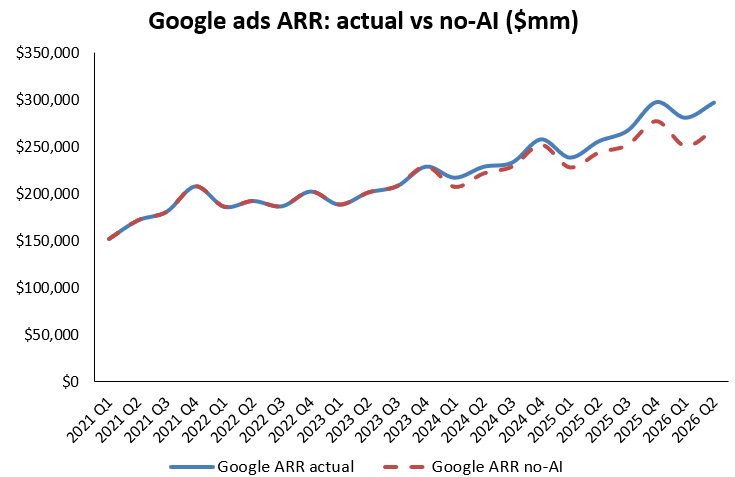
Overall, our best estimate is that AI has boosted Google’s current ARR with $30 billion and Meta’s with $65 billion. So, a boost of $95 billion in ARR in total for the two internet giants alone. This the part that most market commentators miss when they discuss the revenues and IRR that AI is actually generating.
Third, also clouds are bringing in substantial AI revenue. In the below table, we stripped out compute sales to frontier AI labs (Anthropic + OpenAI) in order to avoid double counting. In total, we get to $66 billion in ARR by year end:

Next, we have AI native apps and the tokens that SaaS is selling—again, we stripped out revenues paid to frontier labs. These add another $33 billion in ARR in total:

Overall, based on our math above, by the end of this year, we should already have $187 billion in ARR that frontier models are generating (split between the labs and clouds who resell their models). Then, ad-based ARRs for the two internet giants, Meta and Google, have been boosted by $95 billion over the past 2.5 years thanks to AI. We estimate this will increase to $108 billion by year end. Third, the various clouds—excluding frontier lab revenue—should be about $66 billion in AI ARR by the end of this year. Finally, also AI native apps and SaaS are generating $33 billion in AI revenue.
If we sum all of these up, we get to about $394 billion in ARR. There are a few smaller line items which we didn’t analyze above—such as other frontier AI (Grok, Gemini, etc.) and how AI is benefitting other online ads businesses (such as Amazon, Applovin, etc.). If we also include these, we get to $414 billion in AI ARR by the end of this year.
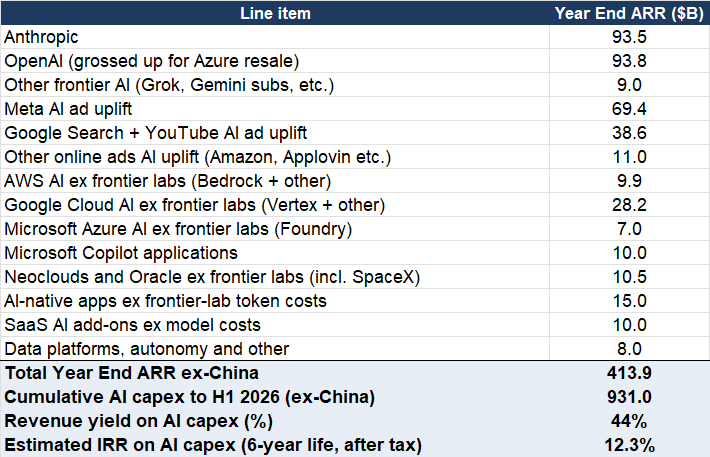
Taking reasonable assumptions, such as a 6 year life for the equipment, this should give an overall 12% IRR on the $931 billion in AI capex made over the past 3.5 years.
Contrary to many reports, we find that AI in aggregate is actually generating substantial revenues and is already generating a healthy IRR for the overall ecosystem. It doesn’t tell you however how this IRR is split. The big tech names such as Meta and Google will be capturing very attractive IRRs, whereas smaller cloud players which are highly leveraged—such as CoreWeave—might struggle to ever make an attractive IRR. As the market has figured out now, rising interest rates are a big negative for highly leveraged companies.
Nevertheless, the above math is a good barometer that both AI revenues and IRRs are already healthy—although some parts of it are hidden in the massive revenue growth which the big internet giants are seeing. This explains why the world remains heavily short on AI compute. For example, both internet giants and frontier labs are now paying neoclouds such as SpaceX and Nebius $40-60 billion per GW in order to get access to the compute they have available. A few years ago, neoclouds were typically signing $10 billion per GW contracts.
In the meantime, models continue to grow more powerful and use cases keep expanding—from coding to 3D design, mathematics, research, medical diagnosis, legal analysis, etc. This is Jensen on the BG2 podcast this week:
“The original GPT probably cost, pick a number, maybe $20 million to do if you wanted to train GPT-1. Now it will probably cost you $100 and we did that in 10 years. Meanwhile, our ambition got so large that the models that we are training now are 3 trillion, 10 trillion, 30 trillion parameters; we are talking about gigantic models now. Our ambition for the capabilities of the technology has gone up.
Our use of it has gone up probably 1 million times. I do not think this trend is going to stop. There is a fairly insatiable demand for intelligence. The smarter you are, the more intelligent you are, the more ideas of applying intelligence you have. The more I have learned in life, the more I realize there is more to do, because every time you learn something, it opens a new door. Every time you open a new door, you see more opportunity, you see more challenges, you see more problems.”
Finally, there is a massive opportunity to boost white collar productivity which we haven’t discussed yet. The global white-collar wage bill is roughly $35 trillion a year. We wouldn’t be surprised if in the coming decade or so, enterprises will start spending 10 to 20 percent of this budget on AI tokens. This would mean that the enterprise tokens TAM in the coming decade already could reach $3.5 to $7 trillion. To meet this demand, $2.5 trillion in annual AI capex would be required.
While many have been screaming ‘bubble’ for three years now—they must be getting really tired—based on the math above, we estimate that the revenue picture in AI already looks very healthy. At the same time, the outlook for further token demand growth is extremely strong. The notion that AI capex is going to collapse at some stage and that ‘this is the biggest misallocation of capital in history’ is in our view pretty foolish.
Many of the voices who have these views were also the same ones claiming back in 2016 already that tech was in a bubble based on a ‘very elevated Shiller PE ratio’. So, this is nothing new for us. Once again, we take the opposite view here and expect the trendline in AI capex to remain on an upwards trajectory over the coming 3-5 years.
We estimate that the $931 billion in AI capex over the last 3.5 years is already generating an attractive IRR for the overall AI ecosystem. Even if smaller cloud players such as CoreWeave, or other neoclouds, blow up due to excessive leverage, this available capacity will quickly get taken up by hyperscalers and frontier labs. The reason is simple—both of these remain heavily short on compute and still have tremendous token growth ahead of them.
Next, we will review the following topics:
Where to position in AI
The outlook for ASML and TSMC
Robotics & physical AI
Our key stock picks in AI