

TSMC’s Outlook
Our view is that we’re in the midst of a long term semis bull market driven initially by the AI data center buildout, which will be followed in the 2030s by the rise of physical AI such as humanoid robotics. TSMC’s CC Wei has a similar view:
“I believe from this day on all the way to probably 2029, 2030, the demand is very strong. Whether in between there’s a dip or not, I’m not very sure. But the trend is so robust that I believe we are witnessing a kind of a new industry. I would like to say the new AI industry, which is so common in our daily life, it’s going to affect automotive, humanoid robots, and also impact all the industry. The amount of money put in by the CSPs alone is a very important new industry to the world, so the demand will be there. And the fundamental thing about semiconductor chips, most of them are TSMC.”
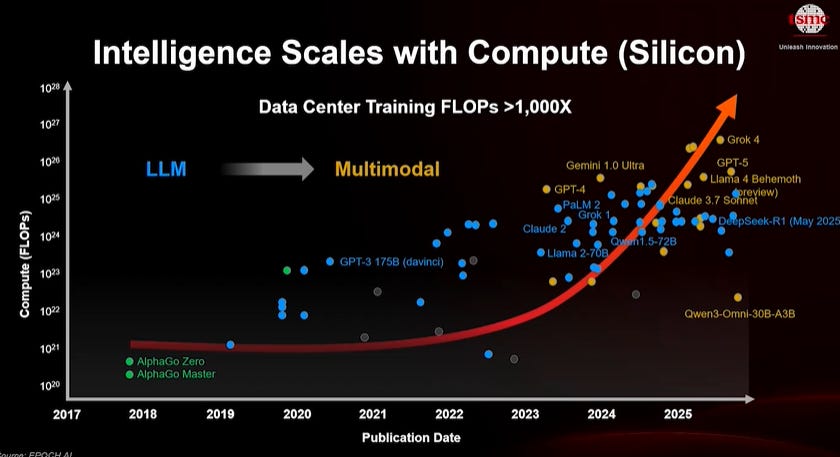
While scaling laws continue to be strong in training:
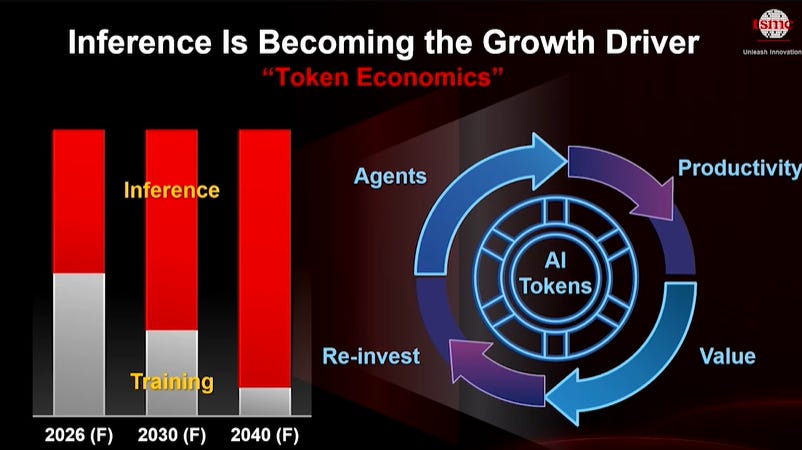
Most of the growth in AI demand in the coming decades will be in inference:
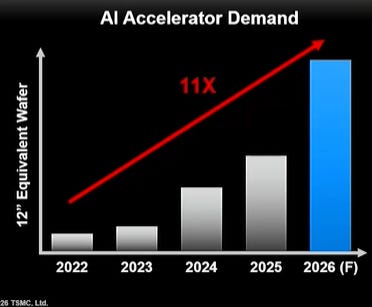
Due to the combination of scaling laws and then the ramp in inference, demand is currently off-the-charts for TSMC’s leading edge nodes. The company showed this nice chart at their recent symposium which is indicating a steep increase once again in AI accelerator demand this year:
In the years ahead, Wei has to estimate where the real demand is going to be. This is how he goes about it:
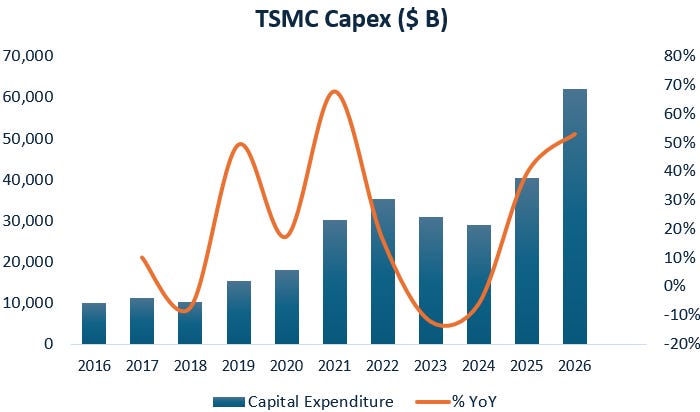
“Because all the customers are very aggressive, and that’s the CEO’s job. CEO got to be aggressive. They give me the number of their demand, and I believe they try their best to tell me the truth. So, I put all together, and all the truths together is not a truth. Mark down that word. So, yes, we do a very careful judgment. May not be correct, but we did carefully because this is big money, right? So, we are checking the AI data centers progress, the building, the location, the demand, the racks, we’re checking all that to make sure that TSMC chips will not be put in inventory. This year, we say we increased the CapEx from $52 billion to $56 billion, now $60 billion to $64 billion. And you bet, that will continue to increase. But, we do it carefully.”
Even with the newly announced capex increase, TSMC’s capex-to-revenues ratio remains at fairly modest levels:
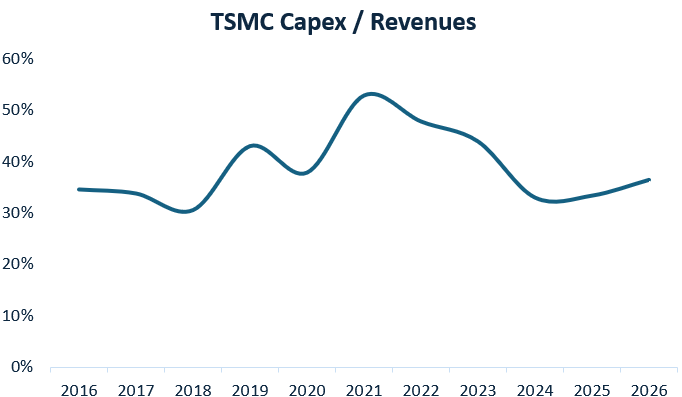
Thus, while TSMC is making new heights in capex, there actually remains plenty of room for growth in the coming years:
Despite TSMC being capacity constrained, the company won’t be doing any exuberant price increases like we’ve seen in Memory. Wei took a few jabs at the Memory players:
“Yes, one of my competitors in South Korea, they make a huge amount of money, and I’m jealous about it. What is the wafer pricing strategy for TSMC, and what kind of gross margin we should have? The higher, the better, of course. But we are a partner, meaning that our customers got to be successful. I don’t want to squeeze them out from the market. And besides, we are a very trustable company with our customers. So we don’t suddenly increase our price by 4x or 5x. Your customer cannot survive for that kind of a price increase. So we earn our value, and we make sure that our profit, our gross margin is enough for a long-term sustaining expansion. That’s to the benefit of my customer and TSMC also. That’s our philosophy. So yes, I’m really jealous about the memory companies, 86% gross margin. I would be happy with that. But, anyway, we are very trustable.”
Wei also knows that the risk with massive price increases is that it will attract new competition over time. While manufacturing DRAM is an advanced set of processes, a key reason that the industry is highly consolidated is that it’s both highly capital intensive and, historically, extremely cyclical. While it has been very pleasant to be a shareholder in these names over the last year, the longer pricing remains at these levels, the more competition will get oxygen as well.
We can already see this with CXMT, China’s DRAM manufacturer, which is seeing a boom in revenues as well given that they’re a price follower. This is also a key reason why the SpaceX-Tesla Terafab will focus on manufacturing DRAM. While neither of these two can really pose credible competition in the coming 3-5 years, exuberant memory margins will attract capital to fund more competition in the industry, and these new players can become more credible competition in the 2030s. While CXMT obviously doesn’t have EUV, the more cash that the Chinese fabs can generate, the more cash they can deploy into the Chinese tooling ecosystem for R&D purposes as well.
Chinese tool manufacturers have gradually been climbing the technology curve over the last few decades, and players such as Naura, AMEC, and ACMR are increasingly manufacturing more impressive tooling. While China is currently far behind in lithography and metrology—the more cash the Chinese chip ecosystem has, the more likely it is that China can pose a threat in advanced semi manufacturing 5-10 years from now. While DRAM manufacturers are optimizing for near term profitability, long term this can come back to bite them. NAND is even worse as this industry is much more commoditized with five larger players plus now also China’s YMTC, which has managed to grab a 13% global market share. So, NAND has already effectively become a six player market.
Advanced semi manufacturing is increasingly considered to be crucial for national security. This is why the Japanese government in recent years has been funding the country’s return to leading edge logic manufacturing with Rapidus. With the current astronomical margins in DRAM, we wouldn’t be surprised to see similar announcements in DRAM, with geopolitical powers such as Japan and Europe potentially calculating that they will need to secure supply in the form of a national DRAM champion. Both these regions were still strong in semi manufacturing only a few decades ago, but were eventually disrupted by Korean and Taiwanese rivals. Europe’s last major DRAM manufacturer, Qimonda, only went under in 2009 following the financial crisis.
Also from a geopolitical perspective, dramatic memory price increases are narrowing the advantage the US has over China, as these will slow down the data center buildout, and raise token pricing. As already mentioned, huge price increases are also making Chinese fabs cash rich, which will benefit the entire Chinese semi supply chain due to higher R&D investments.
So, TSMC’s strategy is really to be the trusted technology partner for all leading edge chip designers, prioritizing long term relationships over short term profits. This is really the beauty of TSMC’s business—while silicon design is much more competitive, TSMC simply takes care of all manufacturing, whether it’s CPUs vs GPUs, or even all the various types of CPUs. Wei explains the company’s strong position:
“The AI market continues to be very dynamic. The emergence of Agentic AI is leading to a resurgence in the role of CPUs in AI data centers, which drives more silicon demand in addition to AI accelerators. We believe this is positive for TSMC as no matter what CPU approach is taken, whether it’s x86, ARM-based, or RISC-V architecture, they are almost all TSMC’s customers. We are already collaborating closely with our CPU customers and working to support them with the most advanced technologies and necessary capacity.”
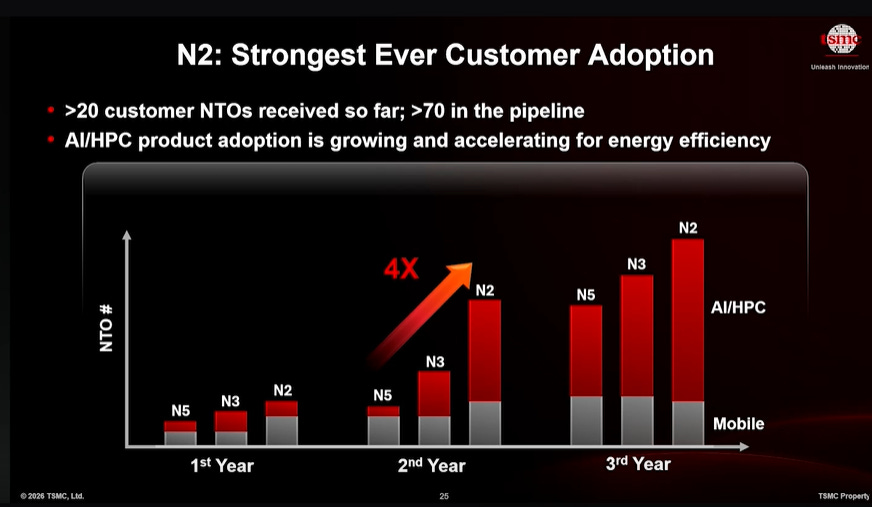
Customer interest in N2, TSMC’s latest node, is strong—with TSMC having more than 20 customers and over 70 in the pipeline:
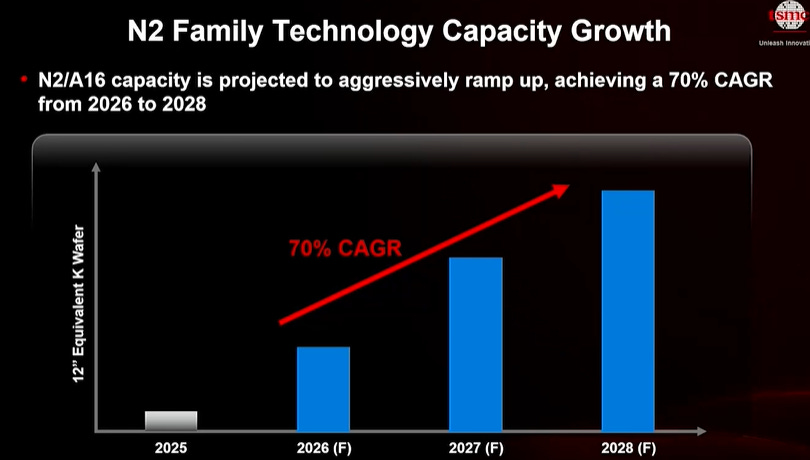
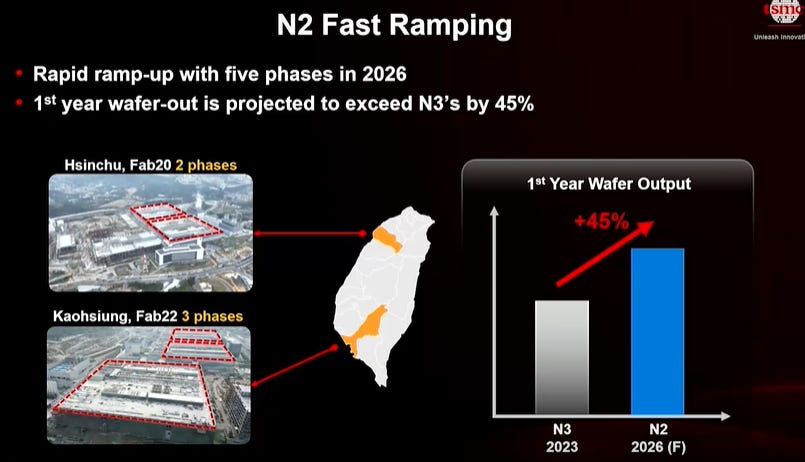
TSMC is planning a steep ramp of N2 capacity in the coming years:
Both Fab 20 in Hsinchu and Fab 22 in Kaohsiung are ramping strongly, with capacity this year already surpassing the N3 ramp in its first year:
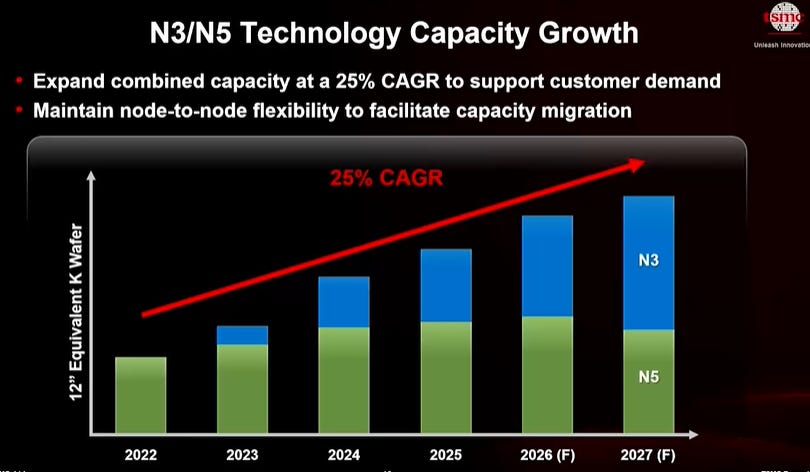
At the same time, the company continues to grow N3 capacity, with tools now being relocated from N5 to N3 fabs:
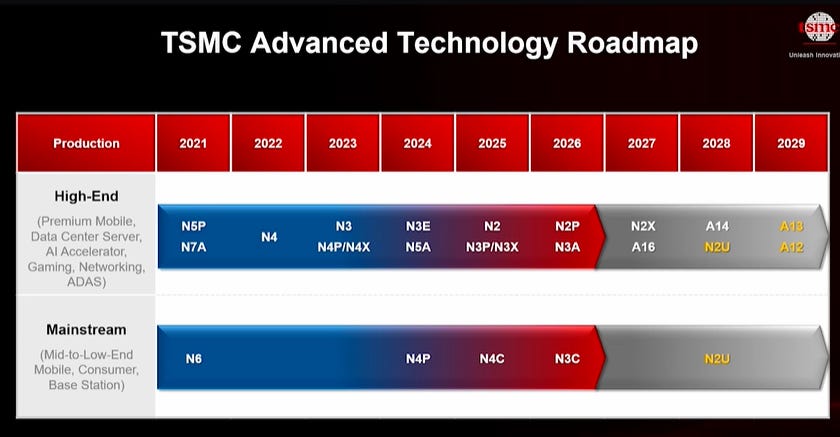
Then, in two years from now, the A14 ramp will start, which will again be followed by more advanced and more specialized variants of this node:
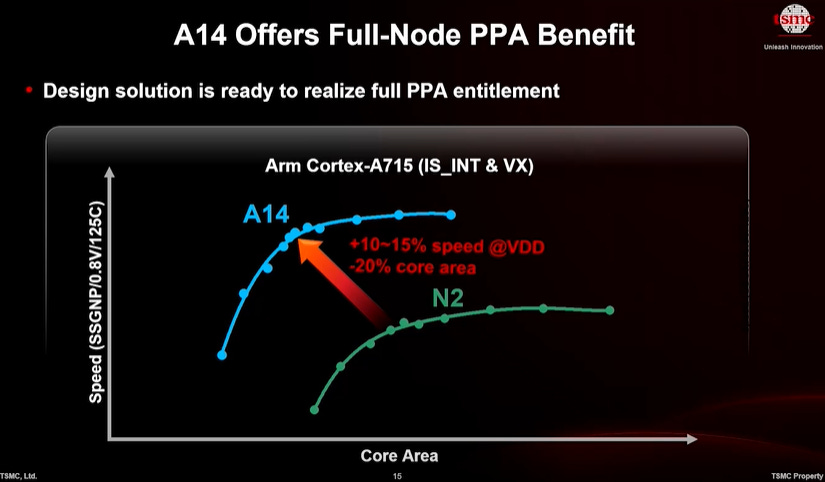
A14 offers again higher speed with higher chip density:
Wei mentioned that the lead time for a new technology such as A14 is 5-7 years—the technology has to be developed, tested, improved, and then capacity has to be ramped.
Next, we will go through much more findings and insights on TSMC, leading edge semis, and what’s next for both. Finally, we’ll also review the current semis sell-off, which names are starting to look attractive here, and which names we’d still avoid.