

An Introduction to the Digital Ads Value Chain & The Trade Desk
Traditionally, publishers such as the Wall Street Journal sold advertising space by closing large deals with ad agencies. The agency was the key player in the middle, connecting publishers to brands. This intermediary had the knowledge of how to run advertising campaigns while as they purchased ad inventory in bulk, they also typically could offer brands a better deal.
In the internet era, this value chain started to fragment considerably and a wide variety of new players emerged. First, there are the ad networks, which dominate large swaths of the online advertising market. The two dominant ad networks, Google and Meta, are amongst the largest companies in the world. Basically, on these ad networks, advertisers and brands can buy inventory themselves to run ad campaigns.
Secondly, there is the open internet, where publishers open up their ad inventory for real-time auctions with each impression being sold to the best bidder. Both price and quality of the advertiser can be taken into account here. For example, Netflix will prefer to show an ad from Nike as opposed to one from OnlyFans. To run this auction process, key players in the middle are the supply side platforms (SSPs) and the demand side platforms (DSPs).
So, when a user visits a website or smartphone app, the publisher’s server will detect that an ad impression is available. The server then sends a request to the publisher’s SSP which collects information about the consumer. Data collected can include age, gender, interests, browsing history, browsing behavior, the smartphone device in use, typical engagement metrics, and geolocation. The richer and more precise the dataset on the user, the more valuable the ad impression becomes.
The SSP forwards this impression to the DSPs, which evaluate the impression to place their bids. To more accurately value this impression, the DSP can make use of additional data it has on the end user, which may have been collected by the DSP, the brand itself, or a third-party data supplier. Data collection on internet users is a fairly complicated industry, with tons of continuously evolving regulations.
The Trade Desk (TTD) is the dominant DSP as it has both the widest and best quality ad inventory available, some of the richest data sets on consumers, the best platform capabilities, and as it is an independent and neutral arbiter in the middle. This final point means that there is no conflict of interest between the advertiser and the DSP. Unlike Amazon’s or Google’s DSPs, TTD doesn’t own ad inventory itself, so it won’t try to unfairly promote its own impressions to advertisers. The sole aim of TTD is to identify the best available impressions for its customers.
Typically, advertisers make use of Amazon’s DSP when they want to run a campaign on amazon.com or Prime Video, while Google’s DSP is mainly leveraged to run campaigns on Youtube. However, the aim of large brands is to re-target potential end customers across a variety of platforms and with different ads. So they might show you one ad on TikTok, another on Spotify, the Financial Times, X, LinkedIn, Netflix, etc. To realize such a multi-platform campaign you need TTD.
An additional advantage is that a good DSP keeps track of which ads have already been shown to each end user. Showing a potential customer the same ad for the twentieth time is just wasted money. So, a clever DSP can create substantial cost savings for customers as it can figure out when to change ads to re-target a customer, or on the other hand forego the impression altogether.
This is a former manager at TTD explaining the company’s strong position in the DSP market (via Tegus):
“The Trade Desk’s value proposition is largely based on being independent as a neutral platform in the middle, while having access to large swaths of inventory across pretty much every streaming player within the connected TV (CTV) space, audio streaming, ads on mobile apps, and every publisher within the programmatic space. Then, The Trade Desk has all sorts of connections to make it easy for the client to bring in their own and third-party data, while also additional data from a publisher itself can be integrated directly. For example, Disney might be willing to share some insights about their audience with The Trade Desk which can be tied to the available impressions.
In CTV, advertisers have been migrating their programmatic buying over to The Trade Desk. Historically, Roku was someone that you would have to work with directly and Netflix was in the same camp, but both are now opening up. And you can also buy Hulu inventory over The Trade Desk. There’s a lot of opportunity in CTV.
Audio is another channel that is often forgotten, and players like Spotify and Pandora are integrated with the Trade Desk as well. Audio pales still in comparison with media spend on Connected Television, but it is growing because the audio platforms have authenticated and logged-in users, and having those types of identifiers is helpful in digital advertising.
The average client on The Trade Desk typically has an annual digital media budget upwards of $10 to $12 million, with some that are spending more than several hundred million a year. Probably more than half of these budgets on The Trade Desk are agency driven, both from major holdcos and smaller specialized agencies, but there are an increasing number of clients that are working with The Trade Desk directly. These have their own in-house teams of programmatic trading desks, but this is only for large companies because it’s very costly.
The Trade Desk is now introducing AI to automate the setup of campaigns, effectively taking over that manual work that’s placed on agencies or in-house trading teams. This creates an opportunity for smaller advertisers to work with The Trade Desk directly, as you don’t have to rely anymore on sophisticated programmatic buyers to set up and manage your campaigns. You can now do this by pressing a few buttons and then smaller advertisers can also get into additional channels like connected television. Minimizing the burden of programmatic buying will allow more advertisers to move away from the ad networks of Google and Facebook—where you can activate a campaign with a couple of buttons and a credit card—to a platform like The Trade Desk.”
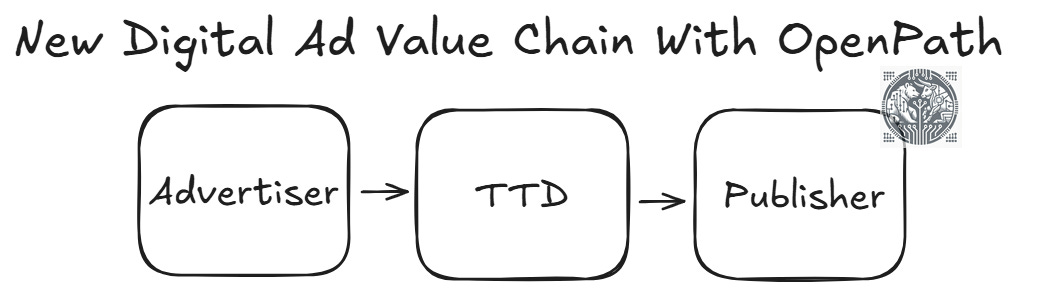
To further strengthen its strong position in the programmatic value chain, TTD has been building direct connections with the large publishers themselves. The attraction for publishers is that most brands are running campaigns on TTD anyways and so now they can forego having to pay the SSP its take rate, which can be substantial. This new feature is what TTD calls OpenPath, and the attraction for TTD is that they can offer the widest and best quality inventory from the open internet on their platform. For example, one smaller agency mentioned in a Tegus interview that it was impossible for them to obtain ad impressions for the Olympics on NBC, however, these easily became available over TTD.
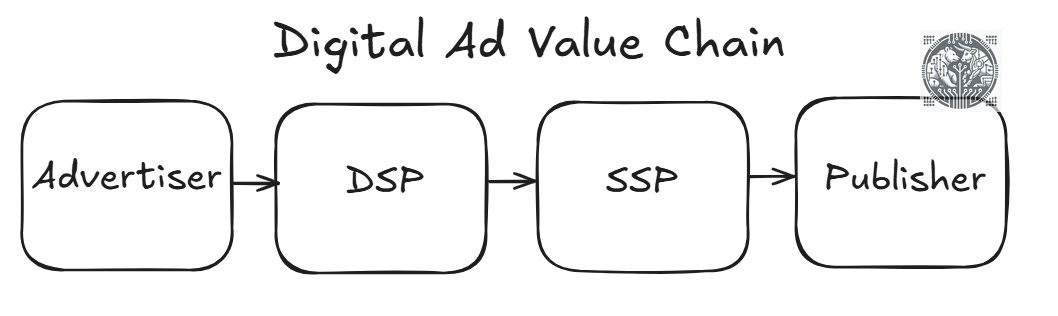
Traditionally, we had the below value chain for digital ads on the open internet. An advertiser uses a DSP to connect to a SSP and then bid on an impression from a publisher:
However, with OpenPath, TTD is putting itself at the center to connect advertisers and publishers on the open internet:
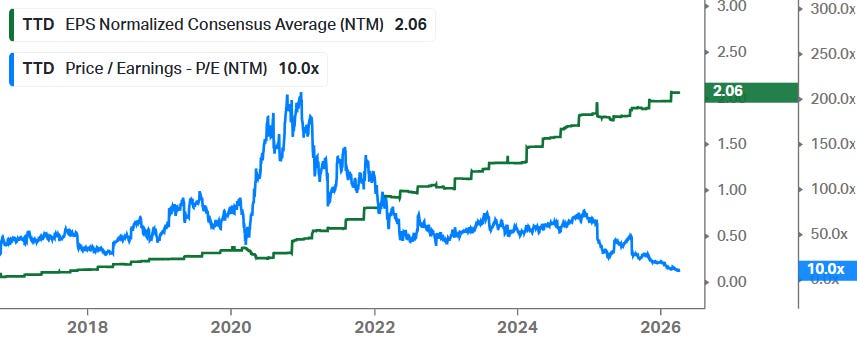
Over the past 1.5 years, TTD shares sold off heavily due to a variety of factors. We can see that EPS performance actually still has been positive, with negative share price momentum being driven by multiple compression. The shares are now trading on a 10x forward PE:
Is TTD a buying opportunity or is the story structurally broken? We’ll go through a variety of interviews with industry insiders as well as insights from sell side analysts to evaluate..