

We enjoyed Louis Gave’s interview (from Gavekal) on the Excess Returns podcast and the bull case he made for Chinese equities in the coming years. Firstly, in the 2018-2024 period, China oriented all their credit flows on stimulating manufacturing capacity. In the viewpoint of the CCP, the US had declared economic war and so the key goal was set for China to become self-sufficient in critical manufacturing. Therefore, credit flows were directed away from real estate and consumption into manufacturing and industry.
In Gave’s view, economists mistook China’s pain during this period for a Japanese-style stagnation. During this time, China built up impressive industrial capabilities in areas such as EVs, batteries, solar & wind power generation, nuclear reactors, robotics & automation, industrial equipment, rail, rare earths, etc. However, as from 2025, the Chinese government started stimulating the demand side of the economy. China is running 10% budget deficits of GDP, pushing credit to consumers and real estate again, and actively supporting equity markets. “China is shifting from being the world’s deflationary shock absorber to a reflationary impulse for the first time in decades.” As a result of its industrial capabilities, China now runs a $700 billion annual current-account surplus.
China’s other strength is that the country has an army of engineers and scientists: “I went to China to university in the mid-90s and back then China was graduating 350,000 university students a year. Today, China graduates 12 million university students a year. And by the way, roughly half of these guys are engineers and science graduates.” Due to China’s strong engineering workforce, there will continue to be strong opportunities in the coming decades in the country’s tech, industrial and life sciences sectors as a few examples. To a certain extent, we’re already seeing this play out with stellar stock performances over the last 5-10 years in certain semiconductor, semicap, software, biotech, EV and battery names.
The most credible pushback to investing in China is the geopolitical risk. When it comes to a war around Taiwan, Gave’s view was that “The closer you live to Taiwan, the less anyone worries. People worry about it in Frankfurt, Dallas or Toronto.” Gave mentions that Beijing has every incentive to wait. It’s likely that the KMT wins the next election, which will open the possibility to negotiate a reunification with a 100-year glide path. Although they would need two-thirds of parliament to close such a deal.
For example, an agreement can be made that Taiwan joins the Mainland 50 years from now under a “one country, two systems” framework like there is in place with Hong Kong. This means that in 50 years, Taiwan will officially join the Mainland, however, it will continue to have its own government, police force, legal system, etc. Then, again 50 years later – so 100 years from now – reunification will be fully completed.
Gave noted that the CCP could have already taken Hong Kong much sooner if they really wanted, for example, as Hong Kong’s water and electricity are supplied by the Mainland. In the decades after World War II, the power of the British Empire started to wane and the empire gradually dissolved. However, China chose to wait and negotiate, until finally an agreement for reunification with a long glide path was made. He sees a similar scenario playing out with Taiwan. The people who will sign off on this deal won’t be alive anymore when it gets implemented, which minimizes risk of personal blowback. What happens 100 years from now is out of everyone’s horizon, and so there is generally little pushback to resolve the situation this way. The British recently gave away a highly strategic island chain in the Indian Ocean, which Trump was fine with, as the US got a 100 year lease on its Diego Garcia base (with a large runway for military aircraft). Note that the British originally also only negotiated a 100 year lease for the New Territories with China as it seemed “forever”. And so, China gets what they want in this scenario, an agreed reunification with Taiwan.
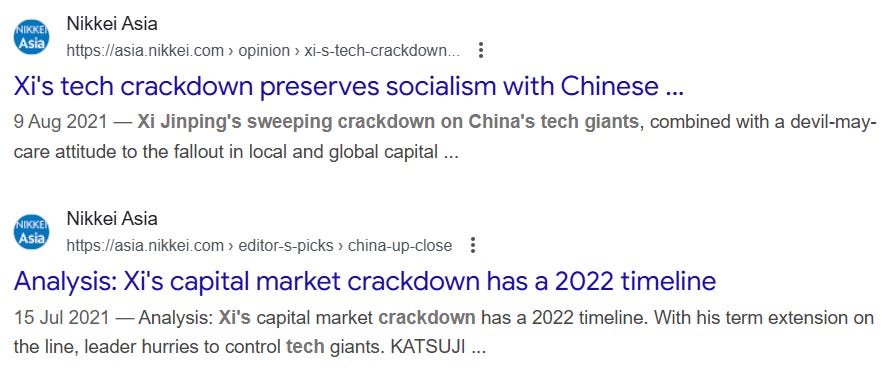
In the 2010s up to 2021, we regularly made investments in China as we came across good businesses with high growth rates and at attractive valuations. However, we sold our positions in ‘21 as valuations became high during the covid tech boom, and while it also was becoming clear that Xi was going to crack down on the names we liked, in order to constrain their power:
Since then, as Chinese equities went into a prolonged bear market, Gave’s view is that “everyone who was going to sell has sold now already”. So, the current shares are now held by steadier hands.
Over the last year, we’ve gradually taken positions in a number of Chinese names again, simply as we thought valuations had become extremely cheap while there are attractive companies in this market. Generally speaking, our typical investment criteria in any market are:
Companies with a dominant or high market share in their niche, or which have a compelling competitive advantage such as strong innovation or engineering capabilities.
An ability to generate high growth rates over the long term.
A valuation that gives investors an attractive risk-reward to the upside.
We’ve found this to be a solid framework to catch multi-baggers over the last few decades. We don’t invest in commoditized businesses or those that are operating in highly competitive environments. While value investors are often drawn to these types of businesses due to low multiples, they frequently underestimate the downside on EPS due to competitive pressures. We’d rather pay a premium on top of deep value multiples in order to get earnings which are much better protected. These are the types of businesses you can buy and hold for long periods of time. Good examples are Google, Amazon, Meta, etc. Same goes for semi names, although it’s best to take profits here when the cycle starts getting stretched.
In this post, we’ll go through a number of Chinese businesses that we like and one Japanese name that we studied this week. Some of these companies are already great, and others can become great five-ten years from now. We are seeing similar opportunities in the market like Nvidia ten years ago, where we first invested in the name in 2015 as we thought that AI – or machine learning, as AI was called back then – could become really big one day. Remember, this was a time when models were still being trained on gaming GPUs, or CPUs even. A PhD training a model on five gaming GPUs in his college dorm was state-of-the-art in those days. A time before Nvidia had sold its first data center GPU..
Finally, we’ll also discuss our thoughts on the outlook in AI and future market share shifts between GPUs and ASICs.