

Scaling Laws & Alibaba
Alibaba held its annual flagship cloud event in Hangzhou this week and the big takeaway for us was that scaling laws are alive and well. AI training times will continue to increase with recursive self-improvement and increasing model sizes. These are the highlights from Eddie Wu’s keynote:
“Consider the early days of electricity: It was initially used only for lighting. In 1882, when Thomas Edison switched on the Pearl Street Station, it powered barely four hundred lightbulbs across a few blocks. Interestingly enough, in the beginning, Edison bundled light bulbs with free electricity, much like how AI agent platforms give away free tokens today. But the inventions that fundamentally changed human life were born much later. Air conditioning appeared in 1902; washing machines and refrigerators entered households years after that. And the first digital computer didn’t arrive until 1946—over six decades after those 400 lamps. Of course, in the age of AI, this evolutionary clock is running exponentially faster.
In the age of Machine Intelligence, powerful infrastructure is equally non-negotiable, and rests on three cornerstones: AI models, AI chips, and the AI cloud. Parallel to the historic rollout of electricity, the demand for AI infrastructure in the era of Machine Intelligence is practically limitless. Alibaba remains committed to building this core infrastructure across AI models, AI chips and the AI cloud as a long-term strategic priority.
AI researchers have also mapped out a concrete path forward: Recursive Self-Improvement (RSI). By engaging with real-world tasks and feedback, models identify their own limitations. They autonomously design experiments, synthesize data, and evaluate outcomes, driving a continuous cycle of self-evolution. Currently, Alibaba’s Qwen team is exploring RSI and has made meaningful progress. The team is continuing to advance research on model architecture and data optimization, and plans to train a new model at the scale of 5 to 10 trillion-parameter, with the goal of completing more complex, longer-horizon tasks and advancing toward ASI.
The second cornerstone is the AI chip. If tokens are the electricity powering the AI era, then chips are the power plants. In the upcoming age of Machine Intelligence, demand for tokens will be virtually boundless, requiring chips to continuously enhance performance and scale supply. Today, T-Head (the semiconductor subsidiary of Alibaba) is building a comprehensive portfolio of data center chips: the “Zhenwu” series for GPU chips, the “Yitian” series for CPU chips, the “Panmai” series for smart NICs, and ICN interconnect chips. The portfolio fully covers the core chips required to build ultra-large-scale AI clusters.
We are introducing our next-generation AI chip, the Zhenwu V900. It is the most powerful AI chip in China today, delivering three times the performance of its predecessor, the Zhenwu M890. A single cluster built on V900 can support up to 500,000 cards to power frontier model training and inference. Backed by the proven maturity of T-head product lines and widespread adoption across our clients, we anticipate a significant growth in the annual AI chip shipment volumes.
However, we recognize that the industry’s mid-to-long-term demand far outpaces our supply capabilities. Global shortages across the AI data center supply chain are currently limiting the speed at which we can scale our compute infrastructure. Our target is that by 2032, the global data center capacity operated by Alibaba Cloud will surpass 20GW, fueling the industry’s exponentially rising demand for AI.
Let history be our guide. When the Industrial Revolution transferred physical toil to machines, humans were liberated from grueling labor. When machines shoulder more of what must be done, humans will have the time to pursue what they truly desire to do. Looking ahead, Machine Intelligence will unlock unprecedented space for human curiosity and creativity. Just as a farmer working in the fields three centuries ago could scarcely imagine that people would one day pay to perform physical exertion in a “gym,” we, too, find ourselves constrained in fully capturing the landscape of what lies ahead. This defines the ultimate purpose of our commitment to the era of Machine Intelligence: to offload onerous tasks to machines while preserving time, creativity, and the appreciation of life’s beauty for humanity. All of this is only just beginning.”
Over time, the cloud and AI will become increasingly important in Alibaba’s revenue mix. Currently, cloud is only 15% of revenues, but over time, when Alibaba has 20GW or more of capacity, the cloud and AI will become dominant in the revenue mix. Especially if they can also start monetizing their Qwen models. For example, in China, demand for non-Western models should be high.
A recent blog post by OpenAI’s chief scientist made a similar conclusion—we’re only at the start of digital intelligence and models will continue to get smarter with scaling and RSI:
“Based on internal results, I have a strong expectation that this speed of progress could be sustained into recursive self-improvement. If AI development continues along its current path, the systems we’ll see in the next few years are likely to represent further capability jumps of equal or larger magnitude, and to increasingly drive their own development. This is a time that calls for extreme caution. I am concerned no one is prepared for the consequences of a continued rapid rise in machine intelligence.
At a high level, progress in machine intelligence is driven by increasing computational power. We at OpenAI deeply internalized this around 2017, after seeing consistent returns to scaling across multiple research projects. As a result, we sought out access to much more compute than we had originally planned, and increasingly oriented our research around a small number of very scalable directions. We believed that was the only way for us to be at the frontier of AI research, and influence the impacts of AGI.
There are new algorithms that have been developed along the way, new feats of ingenuity from teams and individual researchers. I see them largely as discoveries along the path of scaling; the science of deep learning is still nascent, and meaningful algorithmic progress tends to correlate with access to compute. If you zoom out to a multiple-year horizon, AI is continuing to become more intelligent as it is scaled to larger computers.
We spend a lot of time trying to understand how capabilities generalize, and what to prioritize to advance the skills that are going to be most relevant in the next few years. For instance, we believe we could make the models better at specifically mathematics research with additional focus, but we do not prioritize this direction because of the urgency we feel about RSI and automated alignment research.”
A problem for Alibaba, however, is that China is heavily short on advanced compute as they don’t have access to EUV. Although also China is clearly innovating when it comes to advanced semis. For example, we came across this interesting analysis from Bernstein concluding that Huawei’s latest 7nm-like chip outperformed an Apple 3nm chip due to a superior chip architecture. As reported by the SCMP:
“Huawei Technologies’ latest smartphone processor, the Kirin 9050 Pro, unveiled earlier this month, has narrowed its gap with Apple’s chips to about three years, from roughly four years in the previous generation, according to equity research firm Bernstein. The chip, which Bernstein estimated was produced using technology equivalent to a 7-nanometre process node, outperformed Apple’s 3nm A17 Pro in Geekbench 6 multicore tests, a widely used benchmark that measures how effectively processors handle tasks across multiple central processing unit cores.
The research firm estimated that the Kirin 9050 Pro was manufactured using SMIC’s “N+2” or “N+3” process technology, equivalent to a 7nm-class node achieved through deep-ultraviolet lithography, rather than the more advanced extreme-ultraviolet tools unavailable in China due to US sanctions. At the centre of the progress is LogicFolding, a technique developed under Huawei’s Tau Scaling Law framework that stacks logic vertically and uses dense interconnections between layers. The approach reduces the distance signals travel within a chip instead of relying primarily on shrinking transistors. According to Bernstein, the technique increased transistor density to 238 million transistors per square millimetre from about 155 million – a gain of more than 50 per cent.”
Now that the Chinese government has ended the severe crackdown on big tech while recently also stopping the price wars in food delivery between the various apps, e-commerce should remain an attractive cash cow for Alibaba. And then with the boom in token demand, the strong growth of Alibaba Cloud (+45% yoy in the latest quarter) should make Alibaba a growth stock again.
Note that Alibaba Cloud is a major cloud platform in China, similar to Amazon Web Services in the US. And unlike its Western peers, with the exception of Google, Alibaba actually has strong LLM capabilities with its Qwen models consistently being highly ranked among the open-source models. Proprietary LLM capabilities is really an area where the big two Western clouds, Amazon and Microsoft, have been lacking.
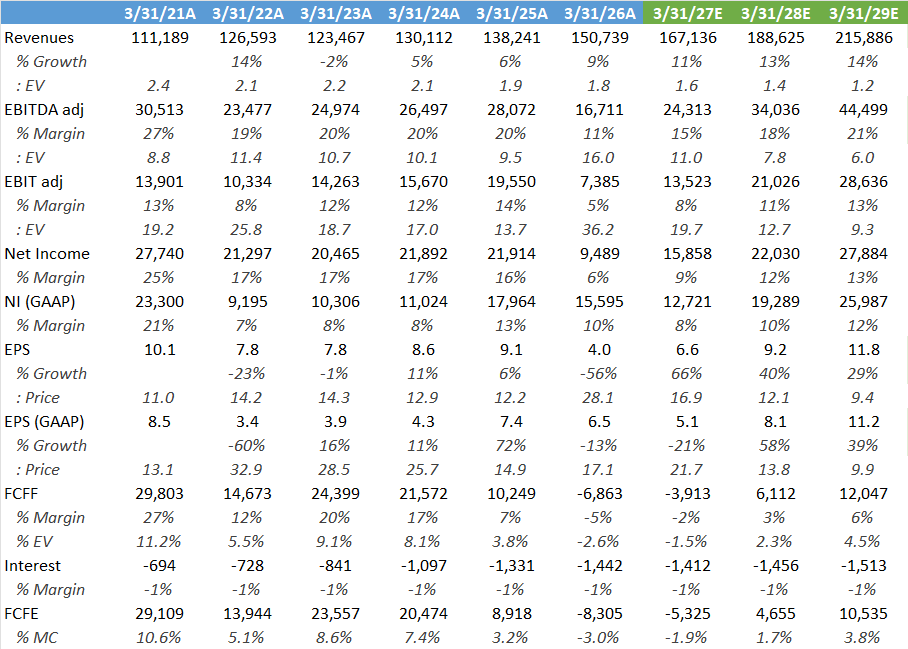
Alibaba is a cheap stock on 14x forward EPS. For people looking to invest in China and in great businesses that can grow with AI, we suspect that these shares will do well in the coming 3-5 years.
Next, we’ll review the outlook and our findings for the following topics:
Hybrid bonding & Besi’s sell-off
Power semis
TPUs in space & the best way to play
As we argued back in May-June, valuations got way too stretched in semis. A lot of fast money moved into the space, driven by the high momentum in semi share prices and with hopes of making quick gains. We were net sellers of semis in that period and locked in some nice profits—we basically halved or moved entirely out of the more expensive names, while keeping positions in names which still looked cheap.
At the same time, we purchased names such as Snowflake and Zscaler which were cheap at the time and which looked like obvious winners from AI to us. The consensus was that software would get disrupted due to vibe coding, but it’s not that simple, and as we predicted, growth actually strongly accelerated for our top picks in software such as Snowflake and Unity.