

Open vs Closed Models
Nebius made an interesting bull case for open source models this week. Basically, enterprises don’t trust the frontier labs with their most sensitive data and so Nebius is seeing demand from enterprises to fully control their own models and infrastructure:
“Customers like big corporations, they are concerned that when they use AI, they need to feed their data back to other companies. They kind of give up all of their secrets to somebody else, which then they incorporate in the universal models and then can be used by competitors to these enterprises. So they would rather see a model which they can control and in an infrastructure they know, and that they can look through to the ground. And Palantir actually have chosen us because we provide this full stack infrastructure which they can have full control of. On top of it, they put their software.
Our token factory provides all kinds of token models—open models, Chinese models, Nemotron and others. Palantir has instruments for the enterprise—which allows them to take their data, take an open model, feed the data to the model, the model generates outcomes, and then they use it as their new data. They feed it back to the model. And after several cycles of training with your own data in your specific domain, it becomes higher quality than the universal model. And that’s what happened with Shopify.
They started with open model Qwen and after several cycles, they reached the level of quality in their specific domain, higher than GPT-5.6. So this cycle—open model and your own data—helps to generate intelligence, which is narrow domain smarter than the Super Duper universal models. That’s the thesis of Palantir. We fully support it, NVIDIA supports it. Probably this is the way to go, or one of the ways to go. Of course, universal models will not disappear. They will have their place. But this is the thing which Palantir wants to do. That’s our partnership.”
This actually makes a lot of sense. For example, if you’re ASML, are you going to run all your proprietary know-how on EUV technology through Claude or ChatGPT? To be honest, we wouldn’t recommend doing that. It makes a lot more sense in this instance to take an open-source model such as Nvidia Nemotron, deploy it in an infrastructure you can fully control—ideally, your own data center even in the case of ASML—and then you can be fully confident that the AI which is assisting you isn’t going to leak any of your biggest secrets.
For example, we were coding over the summer an app with Opus and Opus noted that a setup we were proposing for the workflow was a very clever idea. This month, with the latest Fable 5.1 update, we noticed that Fable proposed a similar setup on its own for another app we were coding. Now, Fable is smarter than Opus, however, it’s also possible that there is a backdoor when you use these models. Claude might have a system prompt along the lines of—“if the user has a very clever idea, or a solution or specific knowledge you haven’t encountered before, send this information over API to this particular database”.
Alternatively, Anthropic can also have Claude read all customer interactions to gather new capabilities. Anthropic obviously does this anyways, this is what they wrote on X a few days ago:
“We’re publishing our most detailed threat intelligence report to date. It covers how people tried to misuse Claude—for cyberattacks, influence operations, surveillance, biology, and building weapons—and how we found and stopped them…”
They’re obviously analyzing everything that Claude is doing and understandably so. Business-wise, it makes sense to use Claude to gather the best ideas and new knowledge from customer interactions so that Anthropic can train the best possible universal model. Being at the cutting-edge frontier in AI capabilities is what generates revenue. It’s the difference currently between a $65 billion ARR and a $1-2 billion ARR. Naturally, this is pure speculation from our side, and we have no proof that this is actually happening. But business-wise, it just makes sense and it would be fairly easy to do this behind the scenes for both Anthropic and OpenAI.
Broadcom’s CEO, Hock Tan, pointed out at the Goldman conference that the current economics of open-source are still terrible, and likely not sustainable:
“The total amount of compute tokens consumed and generated, the cost of generating those tokens to be consumed globally, and this data is obviously for inference, it’s around $200 billion a year now, give or take, rough numbers. That’s the cost of generating those tokens, producing those tokens in infrastructure. Ask yourselves, what’s the revenue you could attribute being created and earned by those model guys. I give you that, around $150 billion. Interesting, isn’t it?
This is generative AI today. I know it’s early stage, things are still growing, but we’re generating $200 billion of token costs to generate $150 billion. But, look below the surface, you can split it up. On those tokens generated, half of it is generated through frontier models, closed systems. The other half generated through players offering open-source, open-weight models. So that’s about it. But you look at the revenue and 75% at least is coming from frontier models. That’s $120 billion, and they spend roughly $100 billion. It’s not so bad and it’s still growing. Let’s look at open-weight models. Spending the other $100 billion, they generate $30 billion revenue. Do you think that’s a sustainable model? We don’t know, but it proves one thing. The value goes to where intelligence continue to improve.”
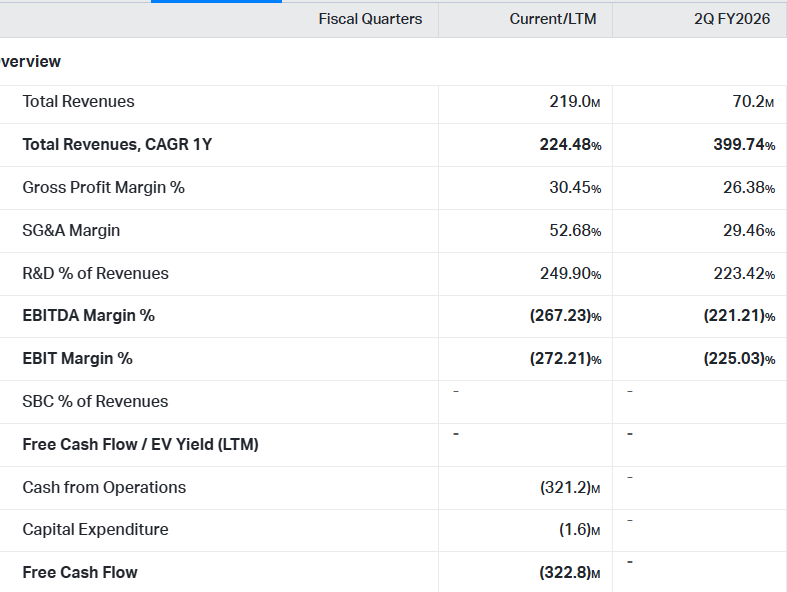
When we look at Z.AI’s financials—the creator of the GLM open source model—we can see that the company burned $323 million in cash over the last twelve months to generate $219 million in revenues. However, we’re still early, and the economics of these models will improve over time as these companies are looking to introduce commercial licenses for enterprises to adopt these models.
Broadcom is also talking their own book here. They’re really the play on closed-source winning as basically all leading frontier labs are increasingly designing their own silicon with Broadcom as their key partner. At the other end of the spectrum, Nvidia is really the play on fragmentation in AI. If enterprises fine-tune and retrain a variety of open-source models, all these various models will need a uniform compute platform and hardware to still get scale advantages in infrastructure.
We see both these scenarios playing out in the coming five years, with the most likely scenario being that token volumes will be split between frontier and open-source models. For enterprises, it makes sense to fine-tune open-source models where they have to handle sensitive data. However, when you’re writing a codebase or doing engineering work where none of what you’re doing is particularly secret know-how (e.g. building a CRM SaaS), it’s clear that both ChatGPT Astra and Claude Fable are state-of-the-art solutions. Therefore, we continue to see both Nvidia and Broadcom as two attractive plays in data center semis.
While the market is currently worried about Broadcom’s market share with Google in upcoming TPU generations, Macquarie points out that ASIC demand from OpenAI and Anthropic will surpass that of Google:
“Our earlier caution rested on Google insourcing its TPU and diversifying to MediaTek (see details here). We believe that risk has played out and is in the price as the shares corrected ~24% from the 2026 high, and Google’s direct investment in MediaTek confirms the shift.
Mgt said Anthropic is on track to become Broadcom’s largest XPU customer from FY27 and guided AI semi rev to double in FY27 and FY28. We forecast Anthropic to purchase >US $40bn from Broadcom in FY28, more than offsetting the Google loss. With Anthropic’s IPO pending, we think Broadcom is the cleanest listed way to own the build. We acknowledge what is secured and treat the FY28 outlook beyond that as timing optionality. Component tightness shifts deployments right, not away, so catch-up toward the guide is upside to our numbers.
Our earlier concern was reliance on a single client (i.e. Google). Growth now rests more evenly on six XPU customers. Mgt sees OpenAI as its second-largest XPU customer by FY28 (>5GW of Jalapeno and its successor) and Meta shipping three MTIA generations (3GW through FY28), while AI networking grows as fast as XPUs.”
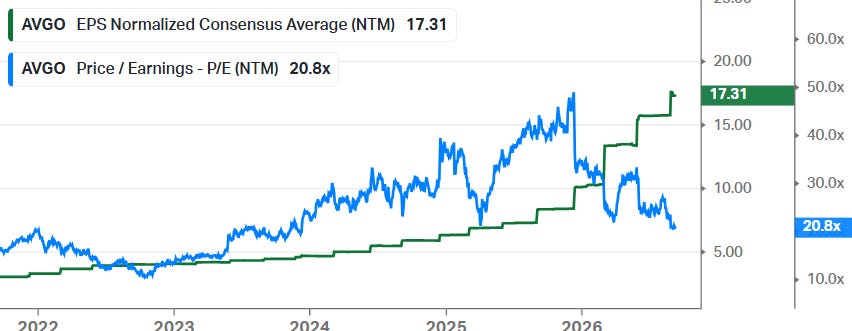
We see Broadcom as an interesting play on the S-curve in frontier AI in the coming 3-5 years, also as these labs will increasingly shift volumes to their own ASICs:
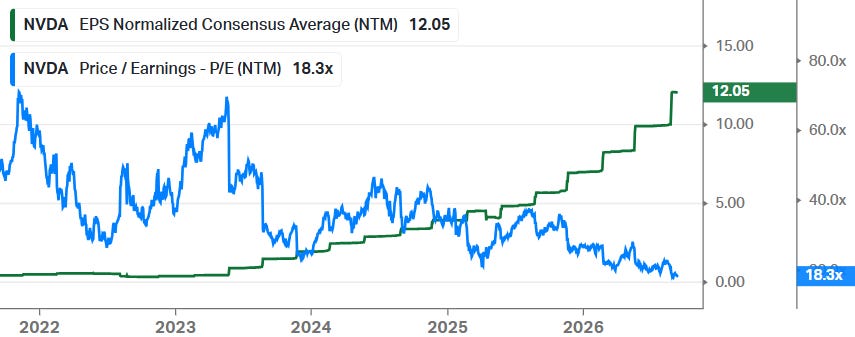
The bull case for Nvidia is that open-source models will continue to have a substantial share of overall token demand, which we think they will, making Nvidia an interesting play on overall annual token growth at 18x EPS. In our view, the bull case for Nvidia is playing out as the company recently upped their guidance again and is now looking at around 70% revenue growth for calendar 2027.
Next, we will discuss our finds on Snowflake and robotaxis.