

Applovin vs Unity
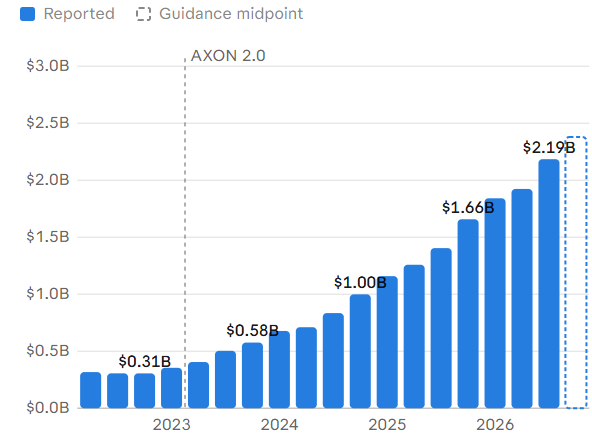
Applovin truly had a whopping quarter with revenues growing at 55% year-over-year:
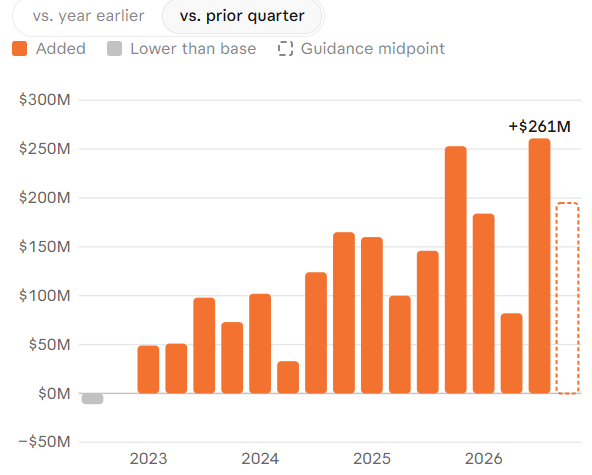
Which resulted in a record step-up of new revenue added:
Applovin’s CEO mentions two key drivers for this stellar performance—more data and bigger AI models:
“Every day that we stay in business, we get customers that come into the platform, they share data with us so we get more data density. So as you fast forward that quarters, years, you then need to pair it with model architecture that can actually process more data and generate better output. So you write a bigger model, more complex model, you train it on a larger compute cluster, and you end up with better output. And what this new architecture allows us to do on the gaming side and on the consumer side, is just train bigger models. We’re never going to stop looking to go get data, whether it’s promoting ourselves through referrals and advertising for new customers, or potentially some sort of data acquisition. We’re going to be looking for ways to get data into this model because we’ve seen every single time we add more data, we’re able to write a more complex model, we’re able to train a bigger model and just get a better output on the other side.”
Good news is that the latest AI models were only partially rolled out during the previous quarter, giving further headroom for strong growth next quarter:
“During the quarter, we partially rolled out the next generation of our models built on the architectural changes. Performance was strong, advertisers saw more spend deploying profitably at their target return-on-ad-spend goals and budgets stepped up. Here’s the part I want you to sit with. This was a partial rollout. The transition is still in front of us, and the new generation gives us meaningfully more room to optimize than the architecture it replaces. It also improves performance most where data is sparser—newer advertisers, smaller advertisers, newer categories, exactly where our consumer vertical lives. As always, model gains won’t land on a perfect quarterly schedule and we won’t promise the cadence, but the headroom is real, and we’re still very early.”
In addition, Applovin is now also heading into its seasonally strongest quarter for non-gaming advertisers such as e-commerce companies:
“Consumer had another strong quarter and with Q4 now underway, the seasonal peak for these advertisers. Consumer is set up very well heading into the biggest spending season of the year.”
However, consumer is still a small part of the business, likely around 15% of revenue.
While training costs stepped up, the company still saw some margin expansion last quarter—although margin growth has become tepid:
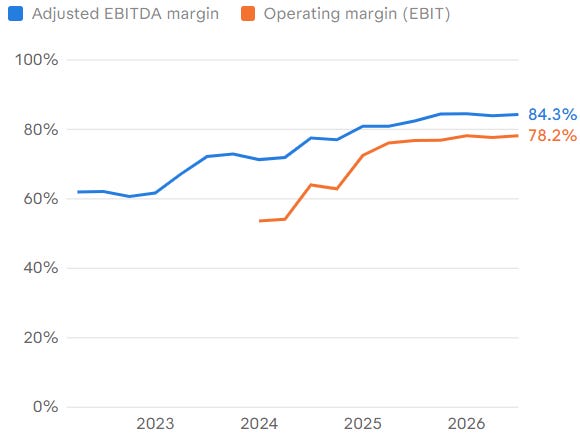
Applovin’s CEO explains that efficiency gains in inference helped here:
“While part of the team trained the new models, our engineers optimized how we serve them. So even as training investment increased, data center costs declined as a percentage of revenue.”
A negative, however, is that gaming advertisers have concerns that return-on-ad-spend drops as more advertisers come onto Applovin’s ad network, such as e-commerce retailers and consumer products. The reality is that Applovin’s ad inventory is limited and with more buyers bidding on this limited supply of available ad slots, the more ad pricing should go up as demand is growing faster than supply. This is good for Applovin, but not for advertisers. UBS mentioned that advertisers are already looking to diversify spend:
“I was talking to some of the advertisers on your platform and they said something curious. They were anticipating that the pricing on the auction is going to start getting inflated because you’re going to have incremental bidders from e-commerce coming in and taking up the prices. So they were preemptively taking some of the budgets to some of your competitors in anticipation of what might be compression of ROI.”
A clear negative for Applovin is that the company’s growth is limited by the number of people playing mobile games and how long they’re playing games in a typical day, as this determines how many ads they can be shown. Another important factor is the purchasing power of the gamer—someone playing a videogame in New York City is much more valuable for advertisers than someone in Mongolia. You pay more to reach people that can actually purchase your product.
However, Applovin’s CEO mentioned that there is still a lot of upside in better ad targeting, which drives higher conversion rates for advertisers. The holy grail of this would be if the AI can figure out exactly which people are interested in which products, and so a target audience gets shown only ads they’re interested in.
“We’re still very low on what we think is the possible conversion rate inside this gaming ecosystem. What consumer gives us is a chance to diversify the ads that someone is seeing. Instead of showing the same user 20 gaming ads in a week, we might show them 15 product ads and 5 gaming ads. That doesn’t mean that the gaming customers lost 75%. It just means that the model can get much more targeted. So those same 5 impressions that would have driven the conversion are still going to sit there. And now all of a sudden, you have all these product ads. So that’s really the focus area. That’s the largest needle mover in the short and medium term. Long term, for sure, supply expansion is something that we’re going to be focused on.”
The company is looking at supply expansion in CTV (connected TV, i.e. streaming) but this is a highly competitive market and one where Applovin doesn’t have a competitive advantage in our view.
In mobile, AppLovin owns MAX—the tool most mobile games use to run their ad auctions. MAX sees almost every ad slot and Applovin’s own ad network bids to buy these. A user clicking on the ad leads to an install or a purchase, and this data loop trains Applovin’s AXON AI.
In CTV, the big platforms (YouTube, Netflix, Amazon Prime, Roku, Samsung, etc.) run their own ad inventory sales, choose which buying platforms get access, and selectively share viewer data. These also favor their own buying tools, such as Amazon DSP for Prime Video and Google’s ad network for YouTube.
In CTV, there’s also no user clicking to complete the feedback loop—users watch the ad on TV and then go to their mobile to find out more about the product. This could happen immediately, or later in the week, or next month even. So, ad conversions are matched indirectly by linking a household’s internet address to purchases on phones and laptops. The signal is slower and noisier, and thus much harder to train an AI model on.
So, the core question for investors is how long this revenue runway can last. Applovin’s CEO guides for revenue to compound at a 30% CAGR over the long term:
“We run one auction across multiple advertiser categories. Gaming keeps improving. Consumer keeps adding runway. And we believe this business can compound at roughly 30% annually over the long term. And as this year shows, we intend to run well ahead of that whenever we can.
Our focus heading into next year is consistent. Complete the model transition and optimize on top of it, expand spend from our current customers while really ramping up the rate of acquiring new customers, keep improving our creative tools and ad formats, and start expanding our efforts on CTV.”
Let’s run some math on how far Applovin’s revenues can grow. Applovin has been a tenbagger since we first reviewed, so, let’s have a look if it can multibag again.

Next, we will review whether Applovin is still an attractive investment here. We will also review Applovin vs Unity, and another name that can generate high revenue growth thanks to AI. The biggest long term winners from AI in our view will be companies that can generate recurring revenues from AI and grow these over time by launching new products and increase automation in the global economy. The name we will review has strong potential to become a multi-bagger in the coming 3-5 years in our view. Lastly, we will also review Nvidia post Jensen’s exit.