

The Iran Conflict – A Gordian Knot
We watched a podcast with Professor Robert Pape from the University of Chicago this week, where he detailed how the Iran conflict continues to worsen when it comes to natural gas and oil supplies.
There are basically three choke points around the Arabian Peninsula. One is the Strait of Hormuz, which is now almost fully closed again. Second, Iran and its proxies could also shut down the other two choke points, on the western side of Arabia, in the Red Sea.
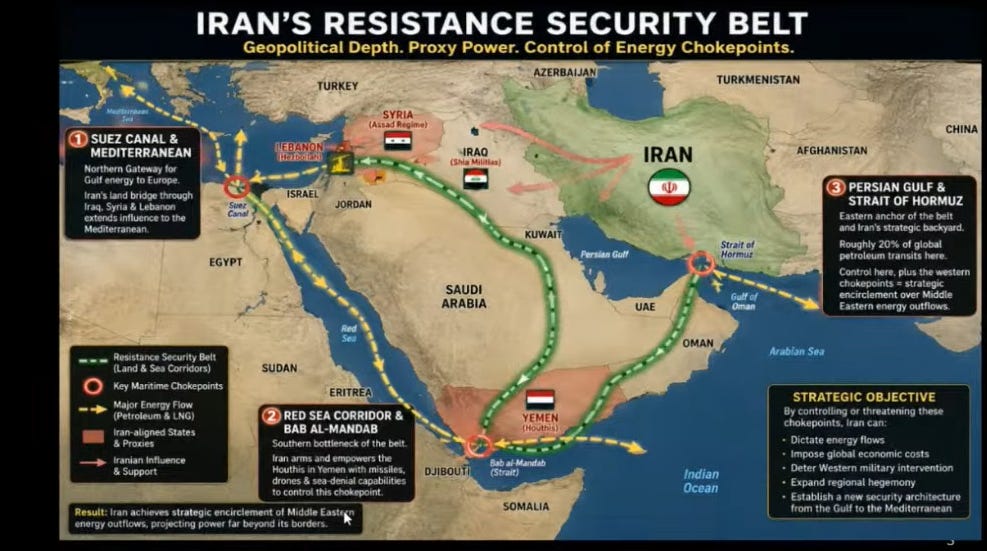
Currently, the Saudis and Emiratis are diverting a small but significant amount of oil via these Red Sea routes:
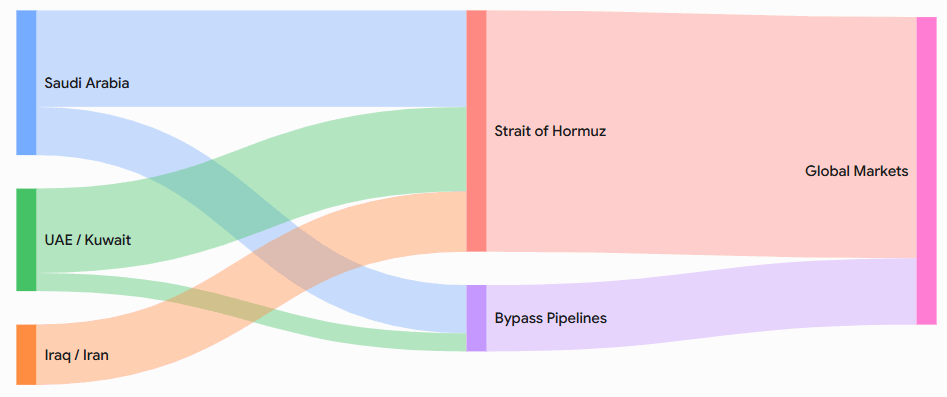
The problem is that after the heavy fighting of March-April of this year, ‘Operation Epic Fury’, the Iranian regime hasn’t collapsed and is still, in fact, in control of the Strait of Hormuz, and with an ability to also potentially close off the other two choke points in the Red Sea. This is Professor Pape on the Mario Nawfal podcast explaining how Iran continues to escalate its demands:
“The first thing to understand here is that Iran’s demands have been expanding, not day by day, but period by period, since the war began. What you can see is in March through May, is that essentially, this is the period where Iran mostly wants peace, mostly wants a ceasefire. They have a little bit of edginess to their demands for money and reparations, but not a whole lot.
Then it transitions to the memorandum of understanding, or MOU. Once we get into the MOU, now we are in the actual bargaining phase. This is where there is negotiation between the United States and Iran on a series of these issues, and also negotiations with Iran and Oman, and Iran wants a little bit more upfront cash in this particular period.
Now we have transitioned, and I put the date as July 7th because that is when the Ever Lovely vessel was attacked. You could have put it a little bit later as well, maybe the 12th, but that would not change the fundamental analysis here. This is the period of unilateral demands. This is the period that we are in now, and I think we are going to be in for quite some time, where the demands have escalated across the board.
This can be explained fairly directly by the declining oil inventories and other buffers. This is basically the chart of the 32 countries that agreed in the middle of March to release 400 million barrels over 120 days. They are still releasing, by the way. But notice the clear trajectory here, it is going to keep going down as the days and the weeks go on because we are going to run out of the cushions. As this goes down, Iran’s leverage has been going up, and its demands have been going up.
The big thing that happened in the spring, even before the MOU, is the West came up with a set of ideas to bypass the Strait of Hormuz. I know because I have been in discussions with a lot of people from the corporate world, in April and early May, saying “No, there is not a problem here with Hormuz, we are just going to bypass it over two years.” Basically, Scott Bessent just revealed the plan, which is that in two years, Hormuz is not going to matter anymore. The reason it is not going to matter is because the Middle East is going to be riddled with pipelines.
There are already some there now, but it will be riddled with pipelines to get energy and other resources out of the Middle East through waterways that do not connect to the Persian Gulf at all. In that situation, Iran then developed, and this became public at the end of May, what the IRGC calls its ‘resistance security belt’. That is when the IRGC generals, the top leaders, started to explain that Iran did not just want peace; it wanted the security resistance belt. That was control and influence militarily from the Mediterranean, which is where the Suez Canal is, to the Red Sea, where the Bab-el-Mandeb is, and through the Gulf.
Basically, the cat got out of the bag because you cannot start talking about building all these pipelines and have this not become public knowledge. That is why Scott Bessent is publicly saying “Do not worry about us conceding on Iran, we are basically going to put Iran and the Strait of Hormuz out of business in two years.” Well, what that has done, is it has defined the goalposts for Iran’s demands. This is not a negotiation. Iran is not negotiating to get economic relief. That is a secondary issue, because if it gets relief today, that can be taken away in two years.
We are just going to put Hormuz out of business, and then we are going to be able to go back to business as usual, pounding Iran’s leaders. We are going to be able to attack Iran whenever we want to, and we will be able to come in and do more damage to Iran. So, this idea of getting economic relief is temporary at best. Power is what dictates what Iran’s security and future are going to look like, not promises by the United States.
What you are seeing here is, since essentially July 7th, where have the attacks been? This is not just a notional concept of a resistance security belt the way it was at the end of May. They are enforcing it; they are doing it. In other words, Iran has moved from survival in period 1, to ambition during the MOU, to hard power in period three. The current situation is a hard power situation where they are not looking to negotiate. They are looking to establish their security resistance belt.
What would Donald Trump have to give Iran to open Hormuz? Well, you see them in the list of demands from the Supreme National Security Council. Number one, the United States has to pull out all of its forces. So, the United States cannot stop Iran’s military control of the security resistance belt. Number two, the United States would have to give Iran money. In other words, fund Iran’s expansion and rising hegemony. By the way, there is also no discussion here at all about Iran’s nuclear program.
Notice that we are about to end the 60-day period of the MOU in just about six days, on the 17th of August. Well, there has been no extension of that MOU. What that means is there is literally not going to be any constraint whatsoever, on Iran’s nuclear programs in about six days. I think this is why we are on a collision course. This is not just a minor set of issues. We are not negotiating on the edges of how to end a war nobody wants.”
President Trump has left the US, and the world, facing a Gordian knot. Iran appears to have a massive set of demands, which look impossible to agree on—for example, giving Iran control of the Strait of Hormuz and the Red Sea, removing all US troops from the Middle East, giving Iran tons of cash, and allowing them to develop nuclear weapons. It looks like this conflict is currently in an escalation trap where things are only going to get worse.
Former Iranian ministers have already mentioned that Iran might well continue the fight into ‘29 and then negotiate with the next US President. That said, reports are mixed—Iran’s own president and central bank chief reportedly told the Supreme Leader the blockade was crippling the economy, and senior negotiators are openly arguing in public that Tehran needs sanctions relief.
The current US plan is a new blockade in the Strait of Hormuz, with the goal of cutting Iran off from the world economy. Secretary of Defense Pete Hegseth has announced that the US Navy intends to maintain this ‘steel wall blockade’ indefinitely by continuously rotating ships into the region. And US Central Command (CENTCOM) recently established ‘Task Force Falcon Strike’ to enforce the blockade using unmanned drone systems in the air, on the surface, and underwater.
The problem is that if this doesn’t get resolved in the coming months, which now looks likely, oil and natural gas prices will start spiking at some stage—either later this year, or early next year. This will likely force the Fed to raise interest rates, which can be a negative factor weighing on equity markets, especially given that valuations now are reasonably high. In case the Fed doesn’t raise rates and decides to let inflation run, well, it’s probably a good idea to buy some gold as well, which is still the best hedge against high inflation.
However, our view is that Kevin Warsh would raise rates under that scenario. He’s made it very clear that he will bring inflation down to 2%, and so we’re not holding any gold at this stage:
“There is no soft inflation target. There is no soft implicit target, not on this committee’s watch. There’s only a target, and it’s 2%.”
Memory Outlook & The DRAM Market
Memory stocks have been selling off heavily over the last few months. The fears are that DRAM and NAND pricing are now peaking. This also isn’t helped by the fact that a lot of news outlets, and other publications, want clicks and so they will publish sensationalist headlines. One of these is that SK Hynix will give a 50% pricing discount on HBM4, JP Morgan comments:
“Multiple investors have asked whether media reports about the SKH team’s pricing HBM4 for 2027 at a 50% discount vs. competitors are accurate. While we believe investor expectations of a 100% y-y HBM ASP increase are stretched, we believe the reports of a 50% pricing discount are inaccurate.
Our relatively conservative pricing assumption (below a 40% y-y increase from 2026E) is associated with three key points:
(1) We believe it is in memory suppliers’ interest to prioritize LTA products for DDR5/LPDDR5/NAND, which are at a significant margin premium over HBM.
(2) NVDA is the largest customer for SKH, with multiple product partnerships, and the company can approach the customer from a multi-year sourcing perspective.
(3) HBM could be re-priced every year, and there is room for price adjustment again in following years (the SKH management view implies a multi- year shortage and short-term HBM contract pricing might not be the top priority if the company prioritizes three to five years’ worth of LTA volume).
If SKH successfully raises HBM ASP above our expectations, this could be a positive upside risk to our EPS projection.”
Clearly there is high dispersion in pricing estimates, Goldman reckons that SK Hynix will be able to raise HBM pricing by 100% in 2027:
“We expect HBM blended ASP for SEC (Samsung Electronics)/Hynix to reach close to US$ 2.9/Gb in 2027E, which would be roughly an 87%/100% yoy increase, respectively. We expect the like-for-like basis price increase to be roughly 60% for major products, and the remaining growth to come from the mix improvement impact.”
We agree with the bullish outlook on pricing, as AI demand growth continues to surpass all expectations. Elon Musk made the best bull case for the DRAM/HBM market on the recent SpaceX call:
“The limiting factor currently is memory. The memory output is increasing by around 20% per year. Now normally, that would be fantastically fast and amazing for any large mature industry. But, the demand is increasing by 200% a year, maybe higher. So if you’ve got demand increasing much faster than supply, then Economics 101 would suggest that the price increases. It does not decrease.”
Goldman also highlights that the HBM:DRAM trade ratio will continue to increase, which will weigh on both DRAM and HBM supply growth:
“We expect the strong HBM demand led by AI servers to continue to outpace supply, and highlight the rising difficulty in ramping the latest generation HBM. This comes from the rising complexity in using a more advanced node for both core die and base die, as well as moving to a higher layer HBM stack, which results in a lower production yield. The higher trade ratio between HBM and conventional DRAM also leads to incrementally less supply of HBM as we move forward to the new generation of HBM. As such, we expect 2027 Supply/Demand to be even tighter compared to this year, which should help drive a favorable pricing environment.”
This is a nice chart from HSBC and shows that while server DRAM pricing has dramatically increased over the last three quarters due to the supply shortage, HBM pricing on the other hand has been flat as contracts are typically negotiated on an annual basis:
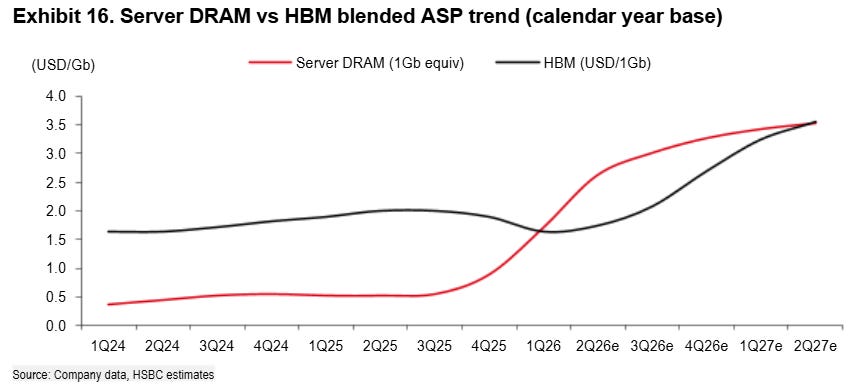
We can also see that $/GB pricing of conventional DRAM is now exceeding that of HBM. This should suggest still a lot of upside on HBM pricing in the coming year. The modeling from HSBC looks reasonable, in our view, especially as supply shortages continue to increase. This is Micron’s CBO at the recent Keybanc conference describing the industry landscape:
“Based on these increased signals of demand from our customers, we now expect that 2027 calendar year will be even tighter than 2026 because the growth in demand that is taking shape is faster than the growth in supply for calendar 2027 on an industry basis. On top of that, we have this issue of HBM growing very significantly. And HBM is needed in these AI systems because in a lot of the workloads, the processor—whether it’s a GPU or an ASIC or a CPU—is sitting idle for 50% of the time, because it is waiting for data from the DRAM. And that is a huge underutilization of an important asset.
And so you need to really get a much higher performance memory bandwidth and a much higher capacity of memory in the system, so that AI can be deployed on an efficient and scalable basis. There is so much demand coming from that. And this HBM increase consequently is creating this 3:1 trade ratio that we have mentioned in the past—where to produce 100 bits of HBM, we have to reduce 300 bits of DDR supply,because there is that 3:1 trade ratio between HBM 3E and DDR.
And when you go to HBM4 and HBM4E, by the time you get to 4E, that trade ratio has worsened to closer to 4:1. So all of this growth in HBM pressures the supply that is left for everything else, which means that the wafer supply has to increase dramatically, and that’s just not easy to do. It takes a long time because the whole industry got itself into a state where most of that expansion was needed to be done in greenfield expansion, which means you go to an empty space, where there’s nothing but trees, and you have to create an entire massive fab cluster there.
So that’s a very challenging endeavor. And while our customers have to build data centers and secure power and real estate; building a data center, no offense to our customers, is considerably easier than building a sophisticated leading-edge technology front-end fab. It’s one of the most complex engineering projects in the world from a construction perspective. And so it takes a long time for these fabs to come online, and this leading-edge technology that gets deployed takes a long time to ramp.
And so because of all these reasons, we don’t have line of sight as to when that supply vector will intersect the demand vector, which continues to escalate with every passing year. And they’re all telling us that the #1 constraint they have today is DRAM. The aggregate demand across all of the segments is at much higher levels than it has been.
Our customers are telling us that despite the fact that the prices are at very high levels, that they’re eager to get more supply. And it’s not just focused on the data center, it’s across different parts of the market. As we engage with customers on these longer-term agreements and near-term supply, their constant feedback is that they are not happy about the extent of volumes we are making available to them. They are signing up in these agreements, but they feel like they’re leaving considerable opportunity on the table across market segments.
Of course, it’s most acute in the data center where quite often, we are not able to meet any more than half of the demand our customers have. And so when we look at all of that, these are like multiyear signals that we’re getting from customers.”
Another concern in the market is despecking—if customers are reducing DRAM content, some in the market reckon that DRAM is not that important after all. However, when you can’t get enough DRAM to ship your products, it’s logical that you reduce the DRAM content to whatever is available. Micron mentioned that they’re only able to meet half of DRAM demand from the data center market. Micron’s CBO explains despecking:
“In our interactions with our customers, it’s not really driven by pricing on the server side as much as it is driven by just lack of adequate supply. Really, our customers are struggling to get their hands on adequate DRAM supply because the extent of supply that is available to them is not going to enable them to ship the units that they need to ship. Consequently, they are focused on balancing how much capacity of DRAM to put in the system with the number of units that they want to ship. And so that is where the modulation of the average capacity in the system is happening, whether it’s in servers or some consumer product.
Despite all of that, when you multiply the units with the average capacity that our customers are planning, the aggregate demand coming from even those new levels of average capacities is rising despite that. Also, there is this phenomena about system performance getting impacted if there isn’t adequate memory capacity. And that kind of change is going to further reduce the potential utilization that the processor is going to have. That means that there is tremendous opportunity to improve the system performance simply by increasing the amount of memory in the system. Once the system is configured and qualified with a certain amount of capacity, increasing the capacity of memory in the system is an easier lift for our customers, and they would be able to introduce a higher-performing SKU and with a higher level of capacity when they see the additional supply becoming available.
Our customers also find that as they make AI systems do more reasoning and get into agentic modes, the context windows lengthen. That requires more DRAM and it ends up spilling over into NAND flash. And so we continue to see an environment where the capacity of DRAM is heavily stressed in these next-generation AI systems.
So, there is all this latent demand out there that comes from being able to increase the average capacities and create SKUs that are higher performing, able to have longer context windows, and much better capability from an overall system performance perspective. But again, it’s not clear on a multiyear time frame when that additional supply will be available.”
If more DRAM would be available currently, customers would be doing the reverse and upgrading the DRAM content of their AI servers. The problem is that the DRAM just isn’t there, and so this creates huge potential for additional demand as next-gen AI workloads scale up.
Next, we will dive much deeper into current developments and data points in the DRAM industry, with our thoughts on whether to buy the dip here. Finally, we’ll also dive into current AI compute shortages and which names are the best plays here. We’re only halfway through the analysis.