

AI & Macro Outlook
2026 has been neatly divided into two halves for semi stocks. In the first half, we saw an incredible bull market with the semiconductor index more than doubling in six months, however, since late June, semi stocks went into a substantial bear market, with the index now down 44% since its peak. Despite this, the index is still up 28% over the last year.
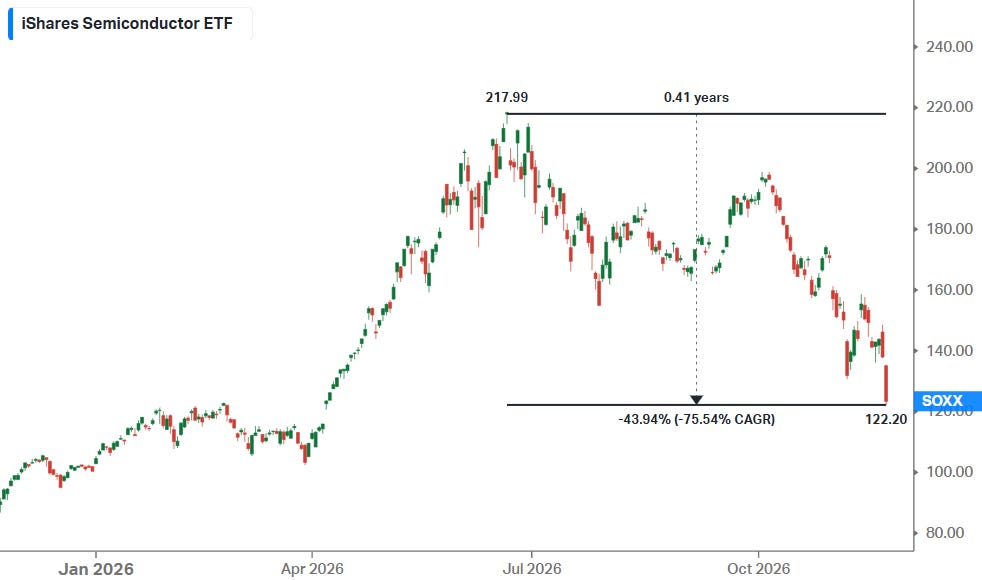
The key tailwind for semis has been the boom in AI capex which started in 2024 and which culminated in a record 113% growth rate in 2026 in AI capex:
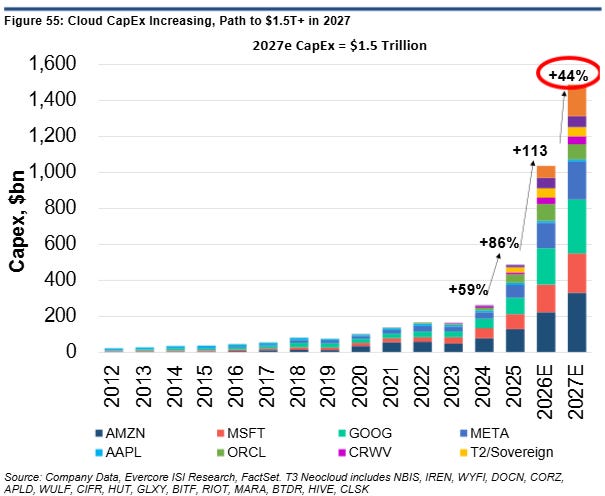
Obviously, the market is now concerned that 2027 will be the peak, or even worse, that forecasts for next year will be missed due to data center delays.
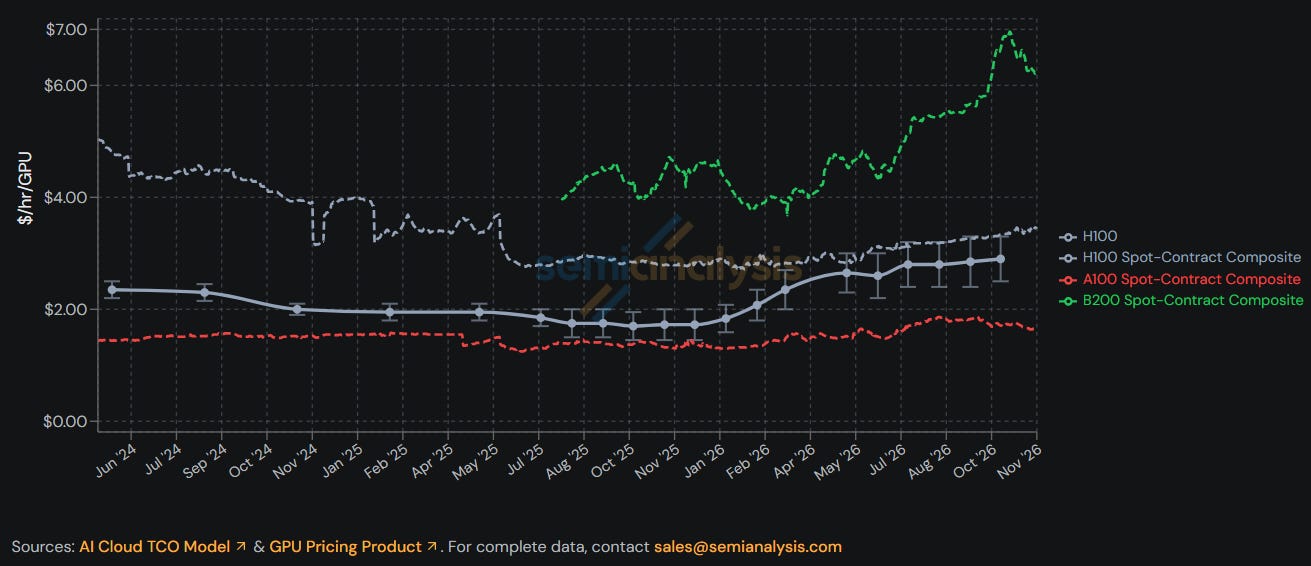
However, we can see that despite a massive amount of AI infrastructure having been brought online during 2026, GPU pricing has remained extremely robust. SemiAnalysis, for example, shows that both H100 and B200 pricing have been trending upwards since July of 2026—when the semi index peaked:
Also Funda’s pricing data show GPU pricing increasing over the last 3 months:
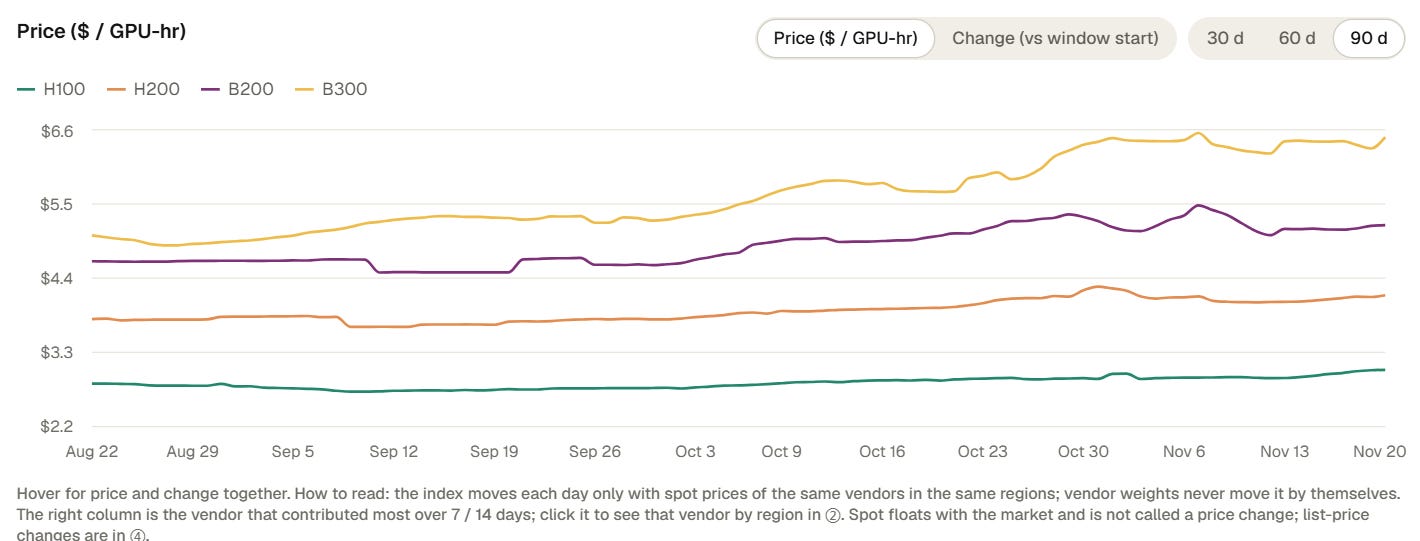
Based on GPU pricing data, we can work out that AI demand has been growing even more rapidly than AI capacity, despite substantial algorithmic improvements in inference efficiency.
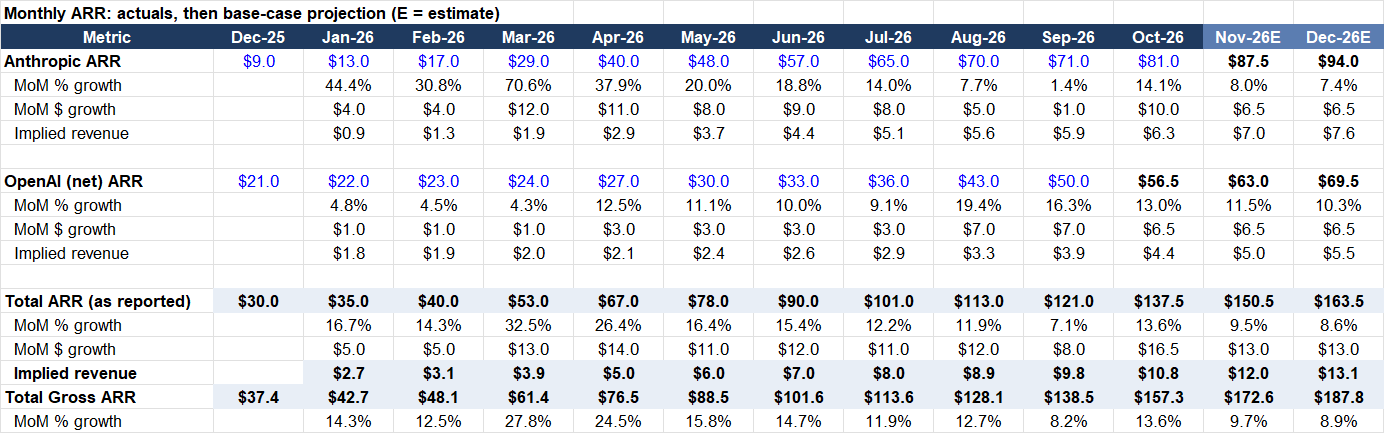
GPU pricing data is not the only indicator of extremely strong AI demand. We can also see this in growth rates that frontier labs are generating, with gross ARR growing from $37 billion at the end of ‘25 to $157 billion last month. Early next year, frontier labs should surpass $200 billion in gross ARR.
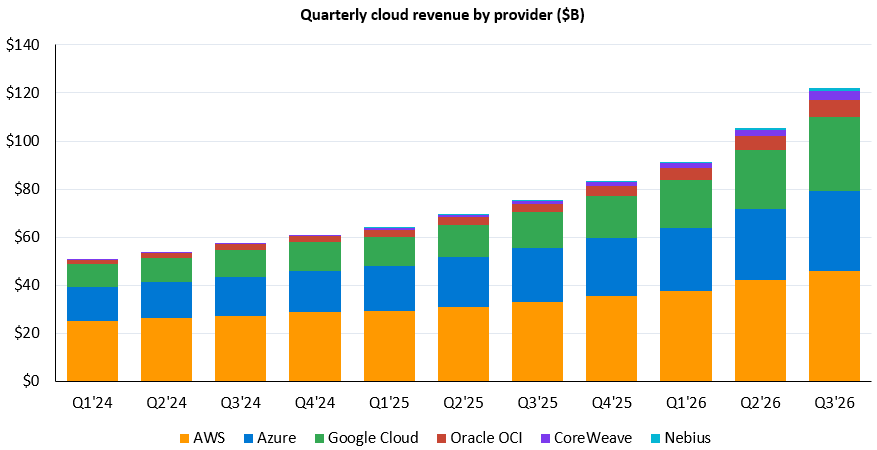
Secondly, we can also find evidence of strong AI demand in cloud revenue growth:
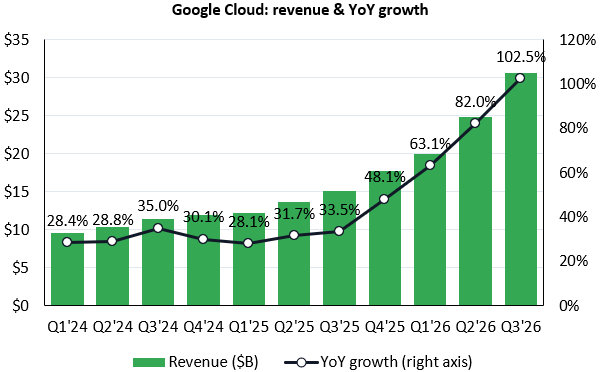
Google is best-in-class among the large clouds and is currently growing its cloud revenue at 100%-plus year-over-year rates. Over time, it’s likely that the company will increasingly transition from a search company towards a cloud-AI-TPU company.
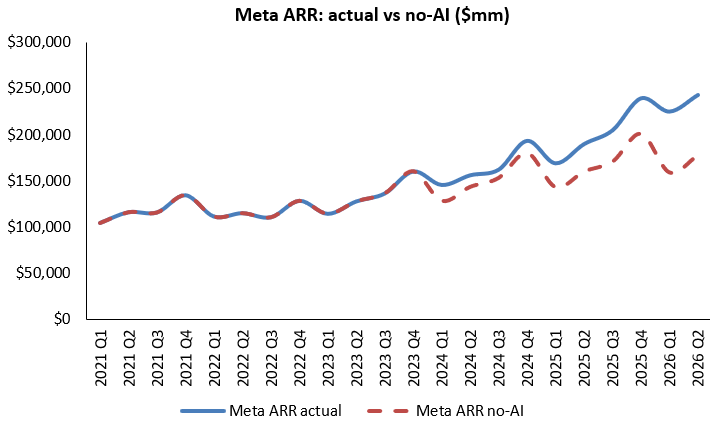
We can also see how ad revenue growth has accelerated at the internet giants due to AI improvements:
Elon mentioned at the New York Times DealBook Summit that Anthropic might need an additional 10GW of compute from SpaceX:
“When I’ve talked to Anthropic, they tell me it is extremely likely that they will continue to rent compute from SpaceX, and in fact that they want significantly more. But they have to say, in a worst-case scenario where there are extreme constraints placed on what AI or superintelligence can do, then they may not be able to use compute. But they’ve told me that their highest probability outcome is that they would like an incremental 10 gigawatts of compute from SpaceX.”
In the meantime, neoclouds are now struggling to meet new AI demand, with CoreWeave’s debt now trading as a junk bond:
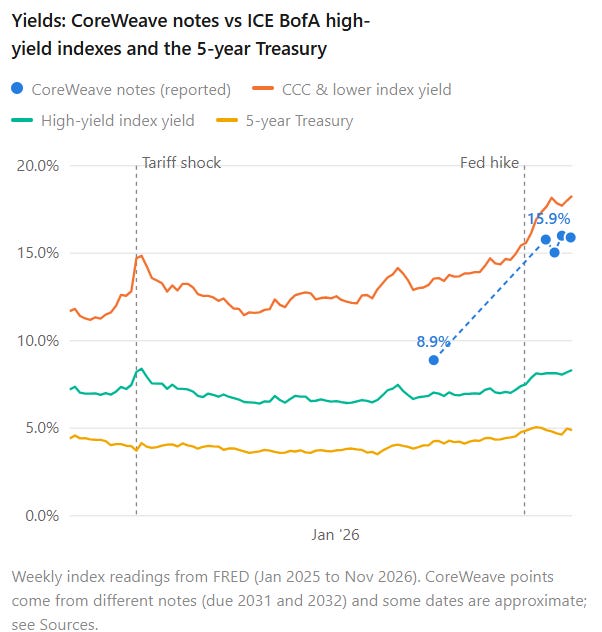
SpaceX is better positioned with the company being extremely skilled at bringing data center capacity online rapidly, which allows it to generate GPU revenues much faster to help cover the capex spend. Another advantage is that SpaceX is selling this capacity at spot pricing—which has continuously been moving up—while CoreWeave is stuck in long term contracts. Basically, per GW of capacity, SpaceX is currently generating the amount of revenue in one year that CoreWeave can make in 5-6 years.
In addition, CoreWeave has $66 billion in debt on its balance sheet, and with very little cash, while SpaceX still has $90 billion in cash and is much better positioned to raise further capital in public markets. It’s clear that SpaceX is currently a massive play on GPU capacity remaining in a shortage, with the company best positioned to add additional capacity and sell it at spot pricing.
Elon mentions that the company is currently bringing online over 0.5GW per month and with a goal of accelerating that to over 1GW per month by the end of next year. This is Musk at the iConnections TomorrowX Summit:
“Right now, in rough terms, we are bringing on about 0.5 gigawatts per month of AI compute, which is roughly 220,000 GB300s plus associated CPU, networking, cooling, and everything. When I say power, I’m talking power at the power plant level, because that’s really the limiting factor. 220,000 GB300s is probably a little over 500 megawatts when you take into account that you will have some power outages on some of the turbines and you need to deal with peak cooling loads. And we’ll be accelerating that next year to over 1 gigawatt a month of AI by the end of next year.
I see these estimates for what it will cost us for 10 gigawatts of compute, and I think they’re off by a factor of 2, most of them, and sometimes more than a factor of 2. When I look at the industry consensus number, I think we’re somewhere around maybe 60% of that number, as a reasonable guess. If you look at my track record, I have a track record of being extremely efficient with capex. I think I might be the best at capex efficiency, but if not, I’m pretty close to being the best.
One of the things that’s different about the way I do things is that we actually do the physical work. The way data centers are currently constructed reminds me of what I call the Jose meme, where there’s one guy digging a hole and eight people watching him dig the hole. I aspire to be Jose: we dig the hole and we don’t just give a purchase order to someone else who does the work. We have an in-house team, not just contractors. We have contractors too, but we have an in-house team which we call Army X that is productionizing the building of the data centers.
We apply the basic principles of productionizing things, where you break the tasks down into things that are easily trainable within a few days. You don’t need people that have been doing networking cables for their whole life. You divide the tasks into things where you can train someone new who may have been a Starbucks barista or stocking shelves at Target.
You’ve got to build the team. These days when I go to Memphis, which I do pretty frequently, it’s becoming a well-oiled machine where it’s just getting done. We run a 24/7 operation. I can walk the site at 1:00 or 2:00 in the morning and see more or less the same productivity as I would the next morning at 10:00 a.m., 7 days a week. The cadence is good. It takes a moment to build that army and build those skills.”
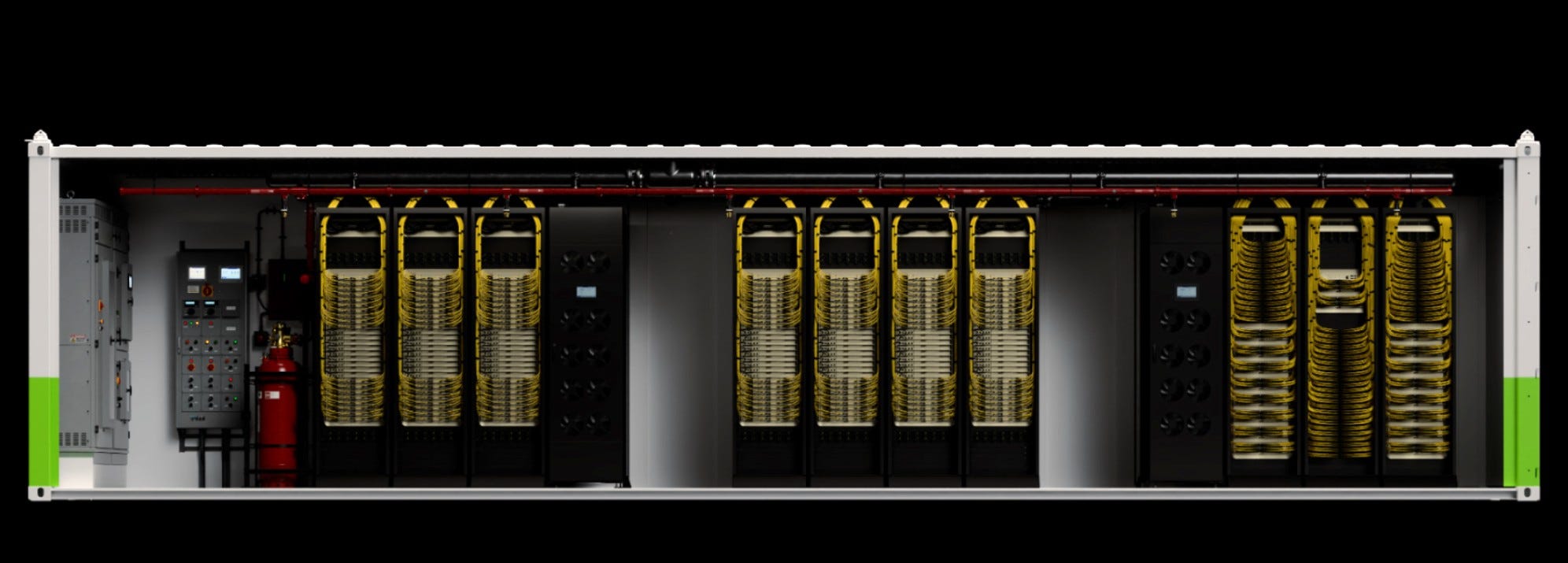
However, Nvidia is aiming to make things easier for the other neoclouds as well. Nvidia pods will arrive at the data center ready to connect, substantially cutting deployment times. Even saving one quarter in installation time can bring in $10 billion in additional revenue as Nvidia’s interim CEO explains:
“Just as Grace Blackwell NVL72 moved rack assembly from the data center into the supply chain, DSX POD extends that approach to the entire cluster. Pods arrive ready to connect, cutting deployment times from months to weeks, accelerating time to first token with annual revenue generating from 1 gigawatt AI factory approaching $50 billion, reaching first token just 1 quarter earlier could generate more than $10 billion in additional revenue for the operator.”
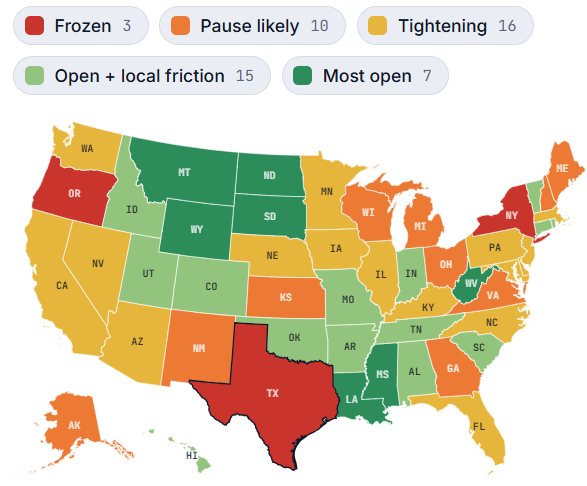
The big concern in the market is that data centers aren’t going to get built. Bear Dan Niles explained his thesis in an interview on Yahoo Finance on Friday:
“The thing that has changed is 40 out of 41 ballot initiatives to halt data center construction passed. And Texas, Georgia, Ohio, New Mexico, Michigan—all those governors flipped, and their platforms were to halt or slow down data center construction. So that is what has fundamentally changed, because if you do not have anywhere to put the chips, well, you are not going to buy the chips at a certain point. So that has changed.”
However, almost all of these measures is written to stop new approvals, and local rules usually exempt projects that already have permits. We think it’s unlikely that newly elected governors would halt data centers already under construction as it would obviously raise local unemployment and increase the risk of a local recession. Also courts generally protect projects that have already secured approvals. For example, Hill County, Texas, withdrew its moratorium after a developer sued. In Ashville, Ohio, voters repealed the village’s deal with EdgeConneX. The company says construction continues because its permits were already secured.
The Texas hold is on approving new grid connections, not on construction. A project that is going up without a signed interconnection agreement could be finished and still have no power. However, there are obvious solutions as data centers can simply install their own power generation (e.g. Bloom Energy). If a data center is ready, is Texas really going to say that the operator can’t install, for example, Solid Oxide Fuel Cells, which produce virtually no local air pollutants? We think that’s a fairly unlikely scenario. So, we think that on-site power providers like Bloom can be big winners here. However, if substantial capacity doesn’t come online as the market seems to be thinking, it sounds like SpaceX will be a big winner as Elon is obviously still building plenty of capacity.
Our understanding is that projects scheduled to come online in 2027 are mostly permitted and already under-construction, and so they’re largely protected. The exposure is more in the 2028 pipeline and beyond. UBS sees pauses affecting about 30% of 2028 capacity additions. However, to get new data centers approved, capitalism is very good at finding solutions. Hyperscalers could easily increase investments into local communities—fix their roads, improve local power networks, build community and sports centers etc.—in return for building a data center in the region. When you’re building a $20 billion data center, you could easily invest $500 million in the surrounding communities.
Furthermore, there is plenty of available space in North-America where new data centers can still get built—both in the US and Canada.
As we saw above, Nvidia’s DSX POD makes it now much easier to bring AI capacity online quickly, which should help operators make their 2027 and 2028 capacity targets. While some slippage in 2028 is certainly possible, which would make 2027 a local high in terms of AI capex, we expect AI capex growth to pick up again in 2029-2030 given the strength of AI demand. Therefore, we expect AI data center capex to remain robust for the foreseeable future and that generally, AI capex will continue to trend higher over time.
We see the following factors driving AI demand. Firstly, the still very low penetration of AI usage in the real economy. Secondly, scaling laws in training and post-training, with more intelligent models requiring substantially more capacity. So far, this scenario has been playing out over the last four years, with currently AI capacity still being in short supply.
The other concern in the market are rising interest rates, however, when we look at real yields, these are still fairly modest compared to historical levels. Historically, we’ve enjoyed strong GDP growth with even much higher real yields .
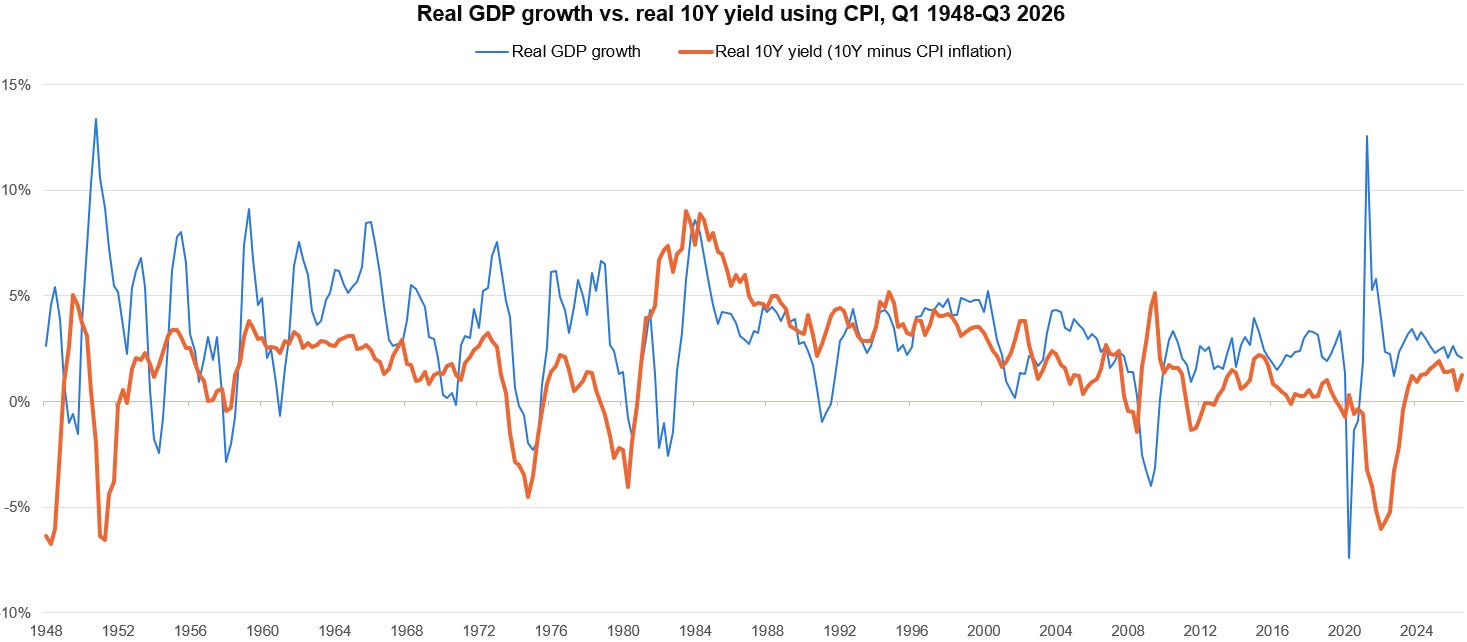
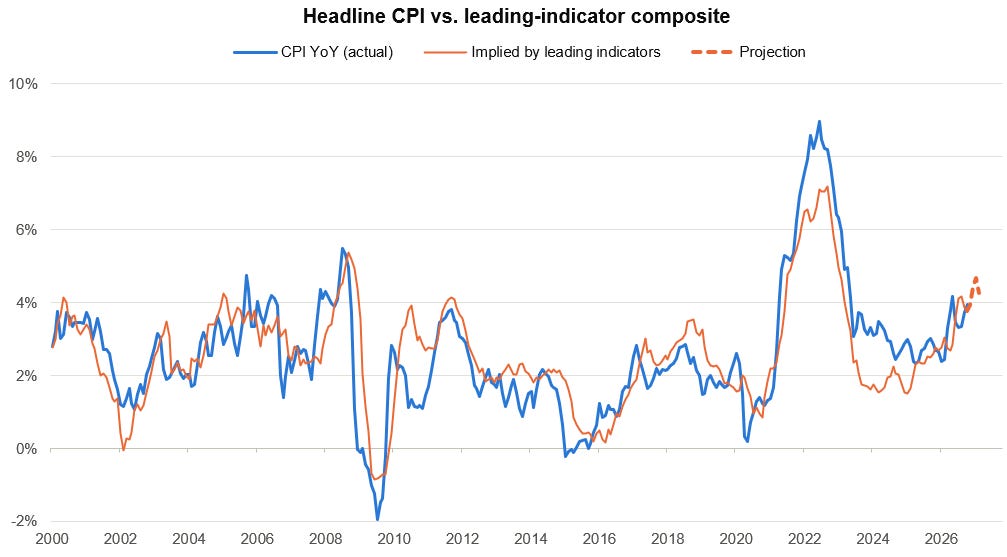
Based on leading indicators, inflation will likely continue to move higher in the coming months. We expect 1 or 2 further hikes of 25bps but we don’t expect this to disrupt the growth story in AI.
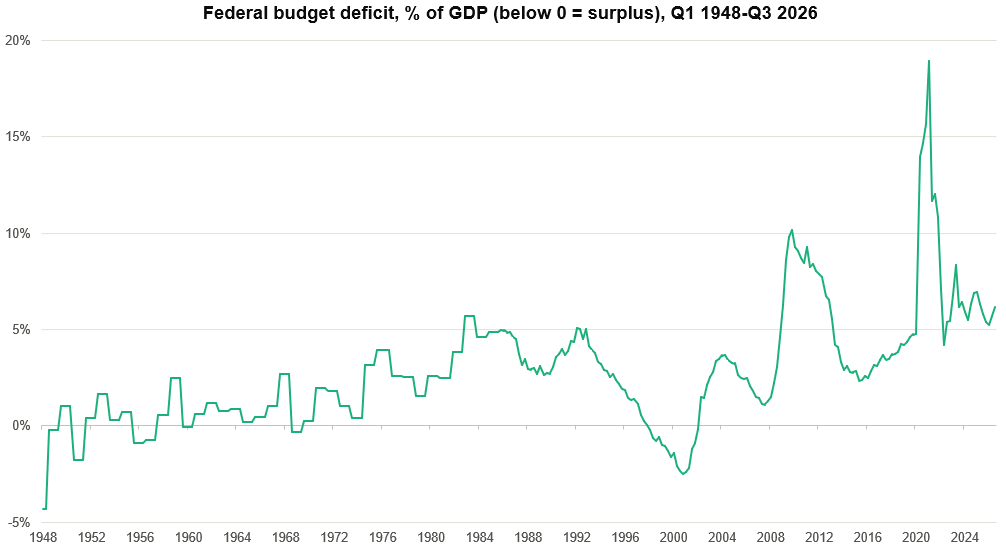
What will likely have an impact on the economy is a Democrat-led Congress successfully bringing down Trump’s massive spending. However, should US fiscal deficits come down, this should help bring down bond yields as well, which will help AI data center investment and the neoclouds especially.
While we’re currently in the midst of a full blown panic when it comes to the AI capex trade, our view is that this panic looks overblown. 2027 could be a local high when it comes to AI investment, but we expect the growth trajectory to resume in 2029-2030. We’re only at the start of global AI demand, and we expect that the demand for intelligence will most likely continue to explode in the coming decade, and beyond that.
AMD and Nvidia are at the center of the current panic due to their exposure to China, both with GPUs being smuggled into China as well as with the Chinese renting GPU capacity at neoclouds. Below, we’ll work out how much China exposure both names should have from these indirect channels. And, we’ll list our top picks in semis currently.