

100% conversion from AI pilot to AI subscription
What we liked in the Manhattan Associates earnings call—the company is a leader in warehouse management software—was a 100% conversion success from AI pilot to AI subscription. This is again a nice data point that enterprise AI adoption is progressing, while we’re still in the very early stages:
“Since our launch in Q1, Active Agents have progressed from an early adopter program to now touching over 10% of our active installed base, either through a pilot or a subscription. And while it’s still early, so far, we have experienced 100% conversion success from AI pilot to AI subscription.”
The bear case on software is that enterprises will code complicated software such as warehouse management and supply chain management systems themselves. However, we think that the market is underestimating the expertise that this requires. Vibe coding a Python app to run on your PC is very different from coding an advanced SaaS that can scale in the cloud to handle Walmart’s volumes, while being 100% secure and reliable.
For example, Manhattan also talked about how customers need the company’s forward deployed engineers to implement Manhattan’s agentic capabilities. So, the idea that enterprises will build all these systems and agentic capabilities from scratch themselves looks unrealistic to us. As we’ve predicted over the last year, bookings and top line growth for quality software names are actually accelerating:
“Some examples of these investments include building seamless agentic AI capabilities driven by Manhattan forward-deployed engineers. Three consecutive quarters of record bookings has given us confidence that our go-to-market approach is working. So regarding some of the specifics on our Q2 bookings, sales to existing customers have accelerated. And in Q2, conversions from on-prem to Manhattan Active represented over 40% of our new cloud bookings. Renewals continue to be in line with our full year plan and net new logos represented over 25% of new cloud bookings in Q2, while our win rate metric remained consistent above 70%.”
So, the consensus thesis in the market that vibe coding is going to eat SaaS, there is no evidence yet. Obviously, Claude is a state-of-the-art coder and our productivity is up 50x or so with Fable. What could be a one-two weeks coding project, Fable can code the whole thing in half an hour or an hour or so. However, this is very different from coding a warehouse management software that can scale in the cloud and run Walmart’s warehouses.
Manhattan ARR per customer is also only around $1 million. Basically, if a company would hire a small engineering and support team to replicate the system with Fable, the cost is still way more than what you’re paying Manhattan. So, the idea that companies are going to code supply chain management software themselves doesn’t make economic sense at this stage. It would only work if Fable can do everything—code it all out and then provide support to end-users, with maybe one or two engineers for oversight. Still, we don’t think it’s worth the risk even in that scenario as switching warehouse management systems are complicated multi-year projects that are a massive risk to the business and P&L. Are you really going to risk your business to save $1 million by moving to your own, unproven, vibe coded supply chain management software?
We think that 90% plus of existing customers will decide to stay on Manhattan, and perhaps 5-10% of the rare, top enterprises will write these types of systems themselves with an engineering team assisted by Fable. So, we think that the call the market is making will be the exception rather than the rule. At the same time, automating workloads for customers with agentic capabilities represents a new opportunity for software. This is also what the recent Bernstein survey found:
“CIOs increasingly expect AI workloads to be cloud-based and prefer packaged solutions from established software vendors over building in-house applications. Importantly, most do not expect AI to replace enterprise software, reduce long-term IT budgets, or drive a shift from software spending toward hardware investments.
Although GenAI is a leading investment area, CIOs do not expect to increase spending on LLM vendors such as OpenAI and Anthropic, reinforcing the view that enterprises prefer consuming AI through established software platforms rather than building capabilities in-house.”
Obviously, Claude is a phenomenal model but enterprises will prefer to fine-tune open source models themselves for their particular workloads, while also simply levering agentic capabilities within existing software systems. There is still a big engineering skillset needed to build all these agentic capabilities, and most companies simply don’t have that talent. So, Manhattan is doing well and this business will continue to do well in our view.
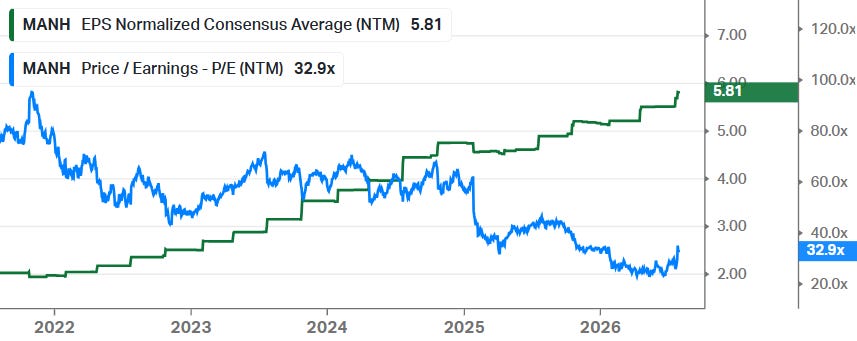
The market has started to realize that selling these shares down to a 20x PE didn’t make much sense as bookings and revenue are accelerating:
Data Management Systems as a Sweet Spot
Manhattan Associates is not the only software name seeing a tailwind from AI. As Needham’s customers checks confirm, data management systems in general are seeing an acceleration in spend:
“Last week, our customer checks indicated Enterprises are definitively using PostgreSQL for Agentic-based, external-facing applications. However, organizations are expressing a more nuanced view of the Database market (compared to investors’ black or white extremes), with the understanding that we are in a polyglot environment. Each database is capable of delivering a portion of the Agentic AI stack.
MongoDB was positively reviewed as capturing a majority of net-new, Agentic-first applications; with customers expecting a yr-yr acceleration in CY26 spend. MongoDB is favored for its JSON document model; offering a flexible schema, promoting Developer velocity, and well-suited for persistent memory use-cases (where the current state of the workload requires memory beyond a single session - like multi-step Enterprise workflows, as an example).”
So, enterprises are increasing their use of various data systems to supply AI agents with the data they need. For smaller applications where engineers are comfortable with SQL, Postgres is a no-brainer. However, if you need vast, unlimited data scaling capabilities and with flexible schemas, MongoDB is the top choice. And if you need advanced analytics capabilities, Databricks and Snowflake are the top choices.
Jefferies notes that Databricks raised more capital as they’re short on GPUs—once again a good indicator of enterprise AI demand. One of our readers had the opportunity to invest in Databricks at $70 billion last year and we told him he’d easily double his money. It’s going to be much more than that. From Jefferies:
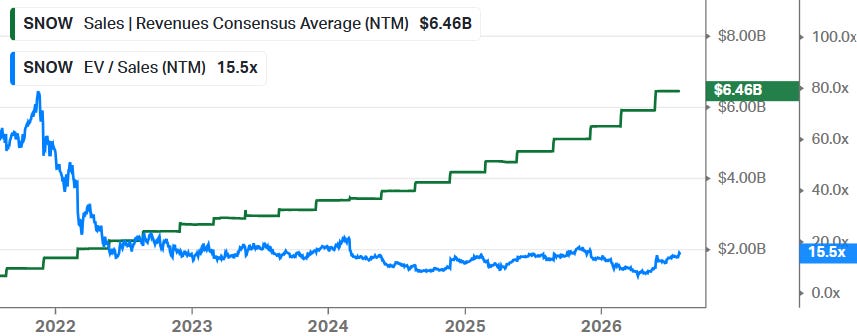
“Databricks is raising $3B, led by Coatue, at a $188B valuation – a 40% step-up from the $134B mark set in Dec 2025. Assuming a 65% revenue CAGR from FY26 to FY28, this implies ~17x FY28 rev. SNOW currently trades at just ~13x FY28 rev on a $100B EV. We see SNOW as a key beneficiary of this read-through, as a rising tide in data cloud demand lifts multiple boats; even a discount at 15x would imply a $310 stock and a ~$115B EV. Reiterate Buy.
Databricks’ CEO recently told CNBC that surging demand for both proprietary and open-source models has left the company running out of GPUs across multiple regions. “We nearly exhausted our GPU capacity in Asia, and demand is rising in countries including Japan, South Korea, the United States, and India. We therefore need to acquire a large number of additional GPUs, which requires significant funding. That demand was what triggered our latest fundraising round: we were inundated with customer requests and needed more GPU capacity”.
We continue to believe the leading data analytics vendors, Databricks and SNOW, are best positioned to help organizations make sense of their business data and apply AI to run analytical workflows faster and more efficiently, and we expect momentum to build across the board. Databricks’ Genie and SNOW’s CoCo/CoWork are both gaining traction, with early adoption metrics inflecting. At the same time, we view the two companies’ aggressive investment in AI-driven analytics as making the competitive landscape incrementally tougher for PLTR. In particular, Databricks’ Genie Ontology adds an enterprise context layer and knowledge graph that could encroach on PLTR’s core value proposition.”
We disagree on the final point and don’t think that Snowflake and Databricks are really threats for Palantir. Palantir is an operational decision layer for lower tech-savvy end-users, whereas Databricks is basically an analytics platform for data scientists. At the same time, Snowflake is heavily focused on business analysts with a SQL background. So, we think that all three will continue to see strong growth, and clearly Databricks and Snowflake are hugely benefitting as enterprises are consolidating their data in the cloud, and increasingly using AI workloads within those platforms.
So, we can see that Databricks has built a UI for lower tech-savvy users to compete more head to head with Palantir (image below), but Palantir has been building out their platform for 10 years. So, we don’t think it will be that easy to actually start winning deals against them.

It’s something to keep an eye on though, as this is clearly a UI that all employees in an organization can use to derive business insights from and then make key decisions, while being powered underneath by the powerful Databricks analytics platform.
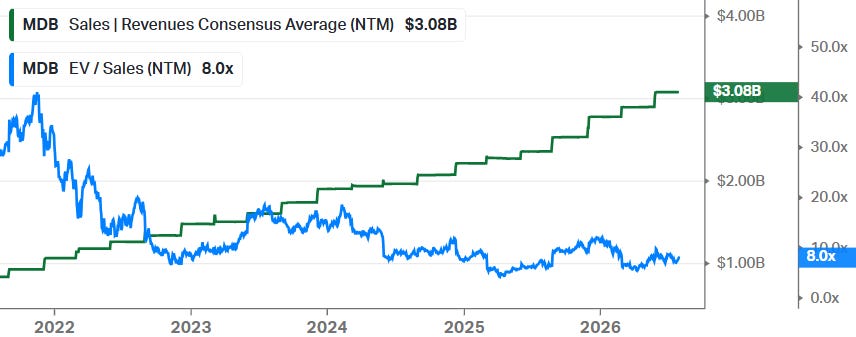
We like both MongoDB and Snowflake. We continue to hold Snowflake and wouldn’t mind owning Mongo, as both these businesses will see tailwinds from enterprise AI adoption.
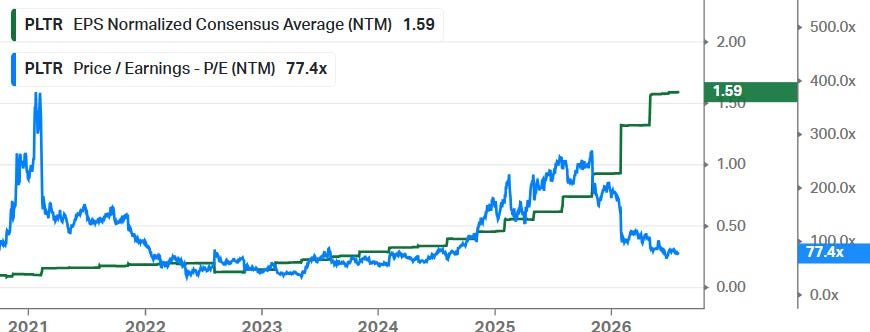
Palantir is starting to look interesting as well—EPS will double this year for a company that’s now trading on a 77x forward PE. This is a name we could pick up if the market keeps selling it.
Next, we’ll go through more investment ideas, data points, and insights from across the AI space—including semis, software, and other names. We’re only one-third through this post.